Cross-Market Temporal Synchronization: Evidence for a Unified Temporal Architecture Across Financial Instruments
Introduction
Foreign exchange pairs, precious metals, commodities, cryptocurrencies, and stock indices differ significantly in market structure. Nevertheless, practical observations reveal that many of these instruments become active during remarkably similar temporal windows. These recurring coincidences raise an important scientific question: Are financial markets synchronized through a common temporal architecture rather than through direct price interaction? The VISTmany methodology proposes that the answer may be affirmative.
Beyond Correlation
Conventional finance explains simultaneous movements through statistical correlation. Correlation, however, measures similarity of price movements after they occur. The VISTmany approach studies synchronization before price movement begins. Time becomes the common reference system. Instead of asking:
“Why did prices move together?”
the methodology asks:
“When were the markets simultaneously activated?”
A Common Temporal Framework
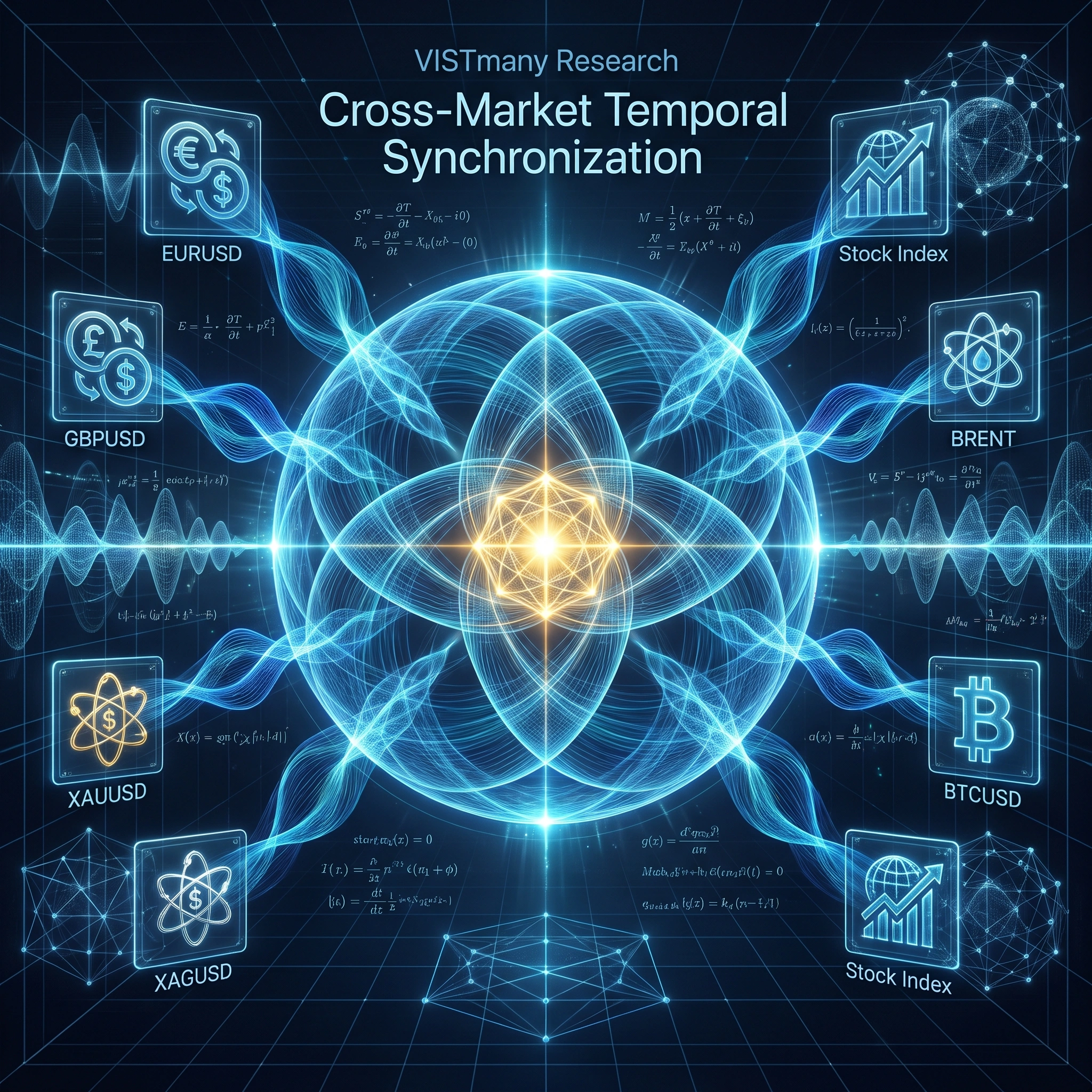
According to the VISTmany framework, each financial instrument possesses its own temporal dynamics. At the same time, all instruments appear to operate inside a larger multidimensional Temporal Space. Individual LAP structures may differ. However, major synchronization zones frequently appear across multiple instruments. This creates the phenomenon of Cross-Market Temporal Synchronization.
Practical Observations
Over several years of observation, VISTmany has identified numerous situations where independent instruments displayed synchronized liquidity activation.
Examples include:
Gold and Silver,
Gold and Brent Crude Oil,
EURUSD and GBPUSD,
Bitcoin and Gold,
Foreign exchange pairs during major institutional liquidity events.
Importantly, synchronization does not imply identical price movement. It indicates simultaneous activation of market liquidity.
Scientific Interpretation
Cross-Market Temporal Synchronization suggests that financial instruments should not be treated as completely isolated systems. Instead, they may represent independent manifestations of one larger temporal structure. This interpretation is consistent with the concept of complex adaptive systems, where local behaviors emerge from common underlying dynamics.
Implications for Financial Research
If Temporal Space governs liquidity activation across multiple markets, then future financial analysis may shift from isolated asset modeling toward integrated temporal system analysis. Such an approach could redefine portfolio timing, risk synchronization, and market interaction studies.
Conclusion
The concept of Cross-Market Temporal Synchronization extends the VISTmany framework beyond individual financial instruments. Rather than viewing markets as disconnected entities, the methodology proposes that they share a common temporal architecture in which Liquidity Activation Points emerge through synchronized temporal dynamics. Further quantitative investigation may establish this phenomenon as one of the fundamental principles of Financial Time Science.
For the formal definitions behind this argument, see Temporal Space, Liquidity Activation Point (LAP), and Temporal Spectrum in the VISTmany Terminology reference page.