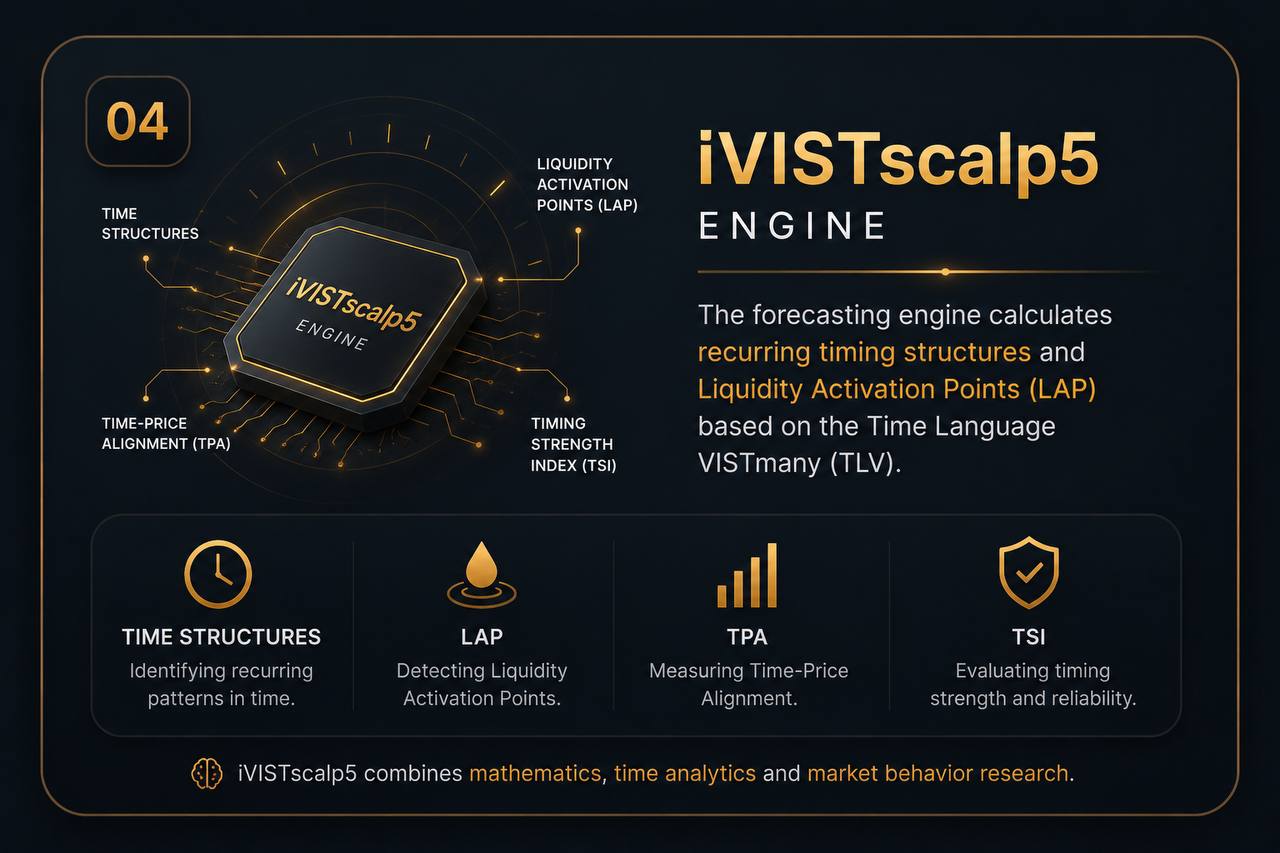
TIME
Forecasted timings.
Liquidity Activation Points (LAP).
Forecasted timings.
Liquidity Activation Points (LAP).
Reaction levels.
Time-Price Alignment (TPA).
Market activation.
Momentum Clusters.
Timing Strength Index (TSI).
Trading decisions.
High-probability timing execution.
The market moves when time activates price
TLV • LAP • TPA • TSI
MARKETS COVERED
•
Forex •
Crypto •
Indices •
Stocks •
Commodities
One timing model. Multiple markets
REAL-TIME
Live timing research available directly on the website.
CURRENTLY AVAILABLE:
and more instruments (soon)
Trade Time. Not Price.
VISTMANY RESEARCH FRAMEWORK
VISTmany is a research and forecasting project focused on the temporal structure of financial markets.
The central idea is simple: The market moves when time activates price.
Instead of treating price as the only source of information, VISTmany studies time as an independent dimension of market behavior.
The system calculates future Liquidity Activation Points (LAPs) - predefined temporal events that can be calculated up to one week ahead for a financial instrument.
Each LAP contains three essential elements:
This creates a forward-looking Temporal Space before the corresponding price movement takes place.
VISTmany is designed to show the temporal structure of the coming trading week rather than simply reacting to what has already happened.
Multiple temporal scales can be analyzed simultaneously. Their interaction forms Temporal Spectra, TimeLife structures and multi-scale temporal configurations.
Shorter timings can help identify local activation, while larger timings can describe broader temporal environments and directional persistence.
The purpose is not to turn every LAP into an automatic trading signal. Instead, VISTmany provides traders and researchers with a structured map of when market activity may become relevant.
The project combines forward temporal forecasting with historical research. VISTmany researchers study how different temporal scales interact with:
This makes VISTmany more than a conventional indicator: it is a framework for studying how temporal structure may precede and influence observable market activity.
The practical side of the methodology is represented by iVISTscalp5, an MT5 indicator designed to visualize forecast timings together with price information.
It allows traders to work with predefined future timings instead of continuously searching the market for possible entry moments. The trader can then combine the temporal forecast with the current price context and make an independent trading decision.
VISTmany also provides a web-based version of iVISTscalp5 inside the VISTLAB laboratory. VISTLAB allows users to analyze financial markets directly in a web browser and observe the interaction between time and market activity in real time.
This creates an accessible research environment where temporal forecasts can be studied without requiring the desktop MT5 terminal. The web version extends the practical idea of VISTmany:
Calculate the future temporal structure -> Observe the market in real time -> Study how price responds when time reaches the forecast timing.
After a temporal event appears, the trader can combine the timing information with the current price context and make an independent trading decision.
The MT5 indicator and its web-based VISTLAB implementation use the same fundamental VISTmany timing concept, providing two practical environments for studying financial markets through time. The project is continuously developing through historical analysis, forward testing and research across different financial instruments.
VISTmany - researching financial markets through time.
Official VISTmany overview — Watch on YouTube