The Temporal Space Density Law: Why Signal Density Matters More Than Individual Signals
- entry;
- exit;
- probability;
- indicator confirmation.
From Individual Signals to Temporal Fields
During two years of historical research we discovered an important empirical fact. Days containing only a small number of generated timings demonstrate unstable behavior. Days containing very large numbers of generated timings produce dramatically more stable market behavior. The transition is gradual rather than binary. Instead of asking “Is this timing good?” the correct scientific question becomes “How dense is the surrounding temporal space?”
Measuring Temporal Density
Temporal Density is defined as the number of generated temporal coordinates inside a fixed observation interval. No price information is required. No indicators are required. Only the temporal structure itself is measured. Density therefore becomes an intrinsic property of Temporal Space.
High-Density Days
Empirical observations demonstrate several recurring properties. High-density days tend to exhibit stronger directional persistence, longer coherent movement, lower structural randomness, higher stability of macro timing clusters. The market appears to organize itself into coherent temporal regions. These regions behave similarly to continuous fields rather than isolated events.
Low-Density Days
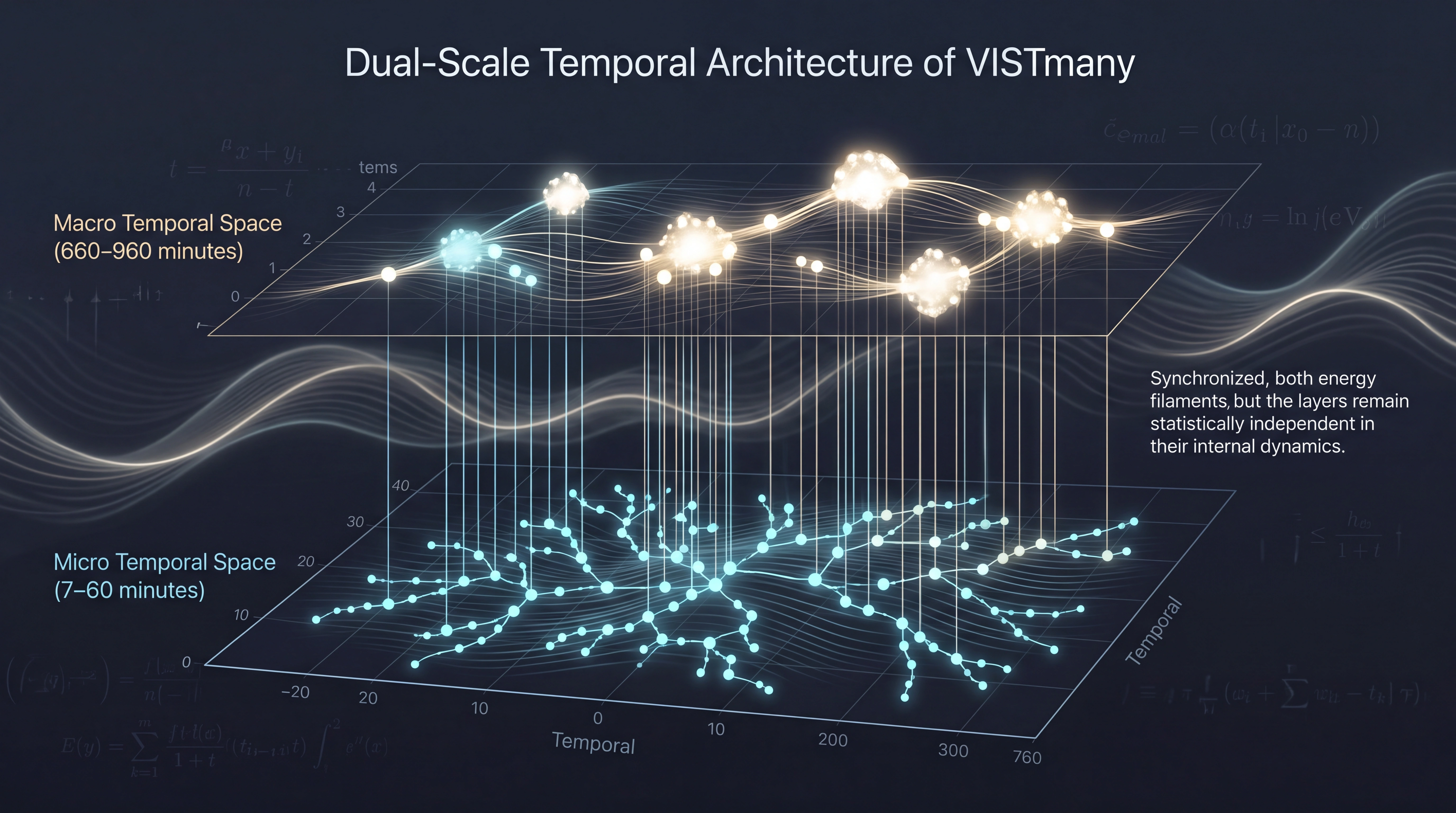
The opposite situation produces completely different behavior. Low-density days demonstrate fragmented movement, unstable direction, frequent reversals, weak synchronization between temporal layers. From the perspective of Temporal Space these regions contain less structural information.
Practical Consequences
This observation changes the philosophy of trading. Traditional trading attempts to improve entry precision. Temporal Space analysis instead evaluates the quality of the entire environment before any trade is opened. In practice, density becomes a market regime filter. Instead of asking “Should I trade this timing?” the system first evaluates “Should this day be traded at all?”
Scientific Importance
Temporal Density is not a trading indicator. It is a measurable geometric property of Temporal Space. It exists independently of price, volatility, trend, oscillators, technical indicators. The field exists before price reacts. Price simply moves inside the existing temporal geometry.
Conclusion
The VISTmany project continues to demonstrate that market organization is determined by temporal structure rather than price structure. Individual timings represent only local coordinates. Temporal Density describes the state of the entire space in which those coordinates exist. Understanding this distinction may become one of the key principles for future temporal market research.
For the corresponding terminology, see Temporal Density, Temporal Spectrum, and Temporal Space on the VISTmany Terminology page.