From Price to Time: A New Methodology for Financial Market Research
The Classical Research Model
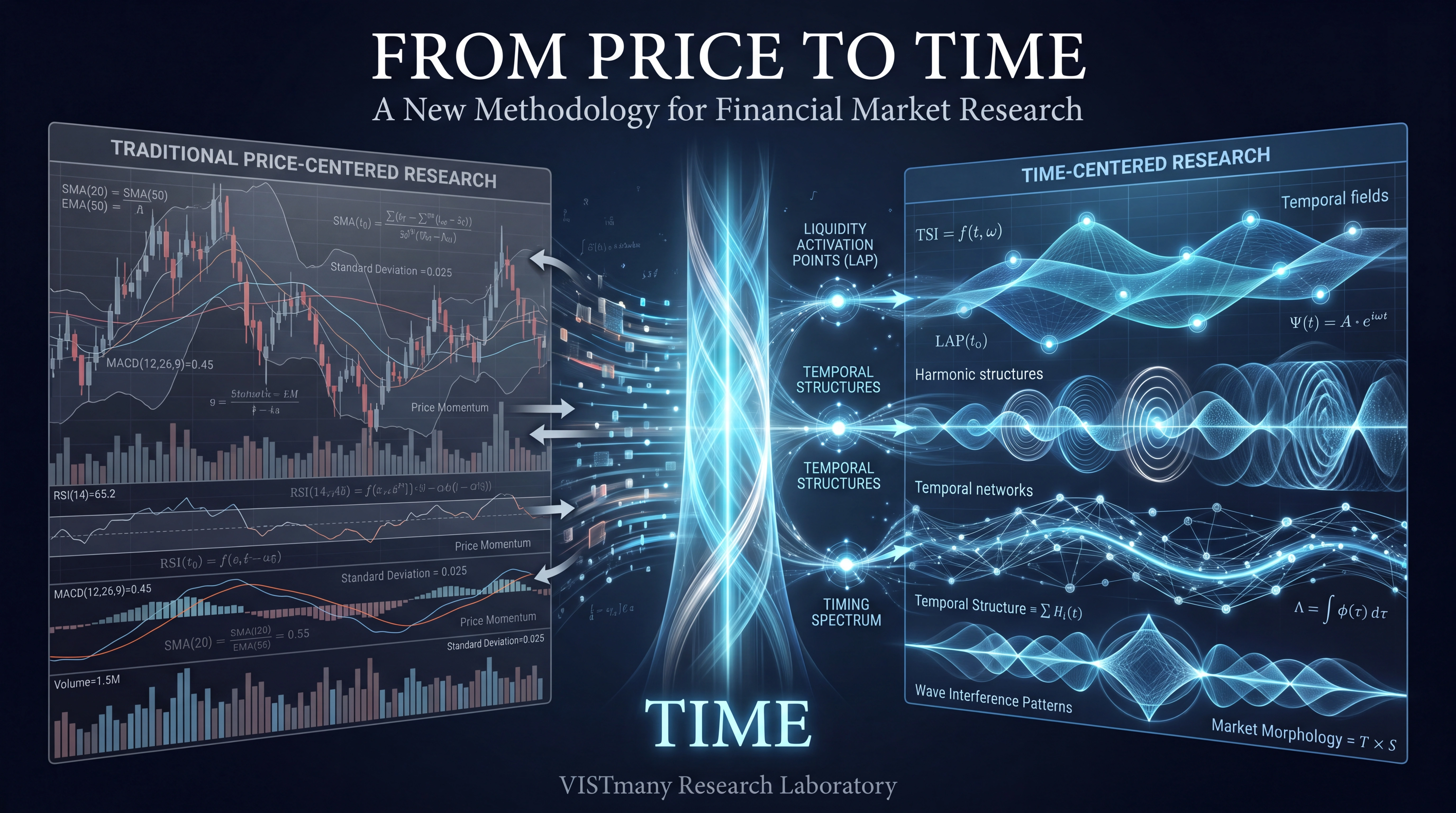
Most quantitative models follow a common sequence: Market → Price → Indicator → Decision Price serves simultaneously as the observed variable and the primary source of information. Consequently, nearly every analytical method becomes a different mathematical interpretation of the same historical price series. Although useful, this framework imposes an important limitation: all calculations begin after price has already changed.
A Different Starting Point
The VISTmany methodology begins from an alternative premise. Instead of asking: “How can price be described?” we first investigate: “Does the market possess measurable temporal organization before price movement becomes visible?” This shifts the research focus away from historical price and toward temporal structures.
Time as a Primary Research Variable
Within this framework, time is no longer treated as a passive coordinate. It becomes the primary observable variable. Price, volume, volatility, and liquidity are then interpreted as responses occurring within predefined temporal structures. This inversion represents a fundamental methodological change rather than a modification of classical technical analysis.
Research Philosophy
The objective is not to predict every market movement. The objective is to identify statistically significant periods during which market dynamics become more probable. Such periods can then be investigated using quantitative methods and validated through long-term observation.
Scientific Validation
Every temporal hypothesis developed within VISTmany follows the same scientific process: mathematical formulation; computational implementation; historical testing; statistical validation; experimental verification; independent reproduction. No model becomes part of the methodology without passing these stages.
Implications
If temporal structures prove statistically reproducible, financial market analysis may evolve beyond purely price-centered methodologies. Rather than replacing existing theories, temporal analysis may become an additional scientific dimension for understanding market behavior.
Conclusion
The transition from price-centered research toward time-centered research represents a methodological evolution. Whether this hypothesis ultimately becomes an accepted scientific framework will depend entirely on mathematical rigor, reproducible experiments, and independent verification. For VISTmany, this process has already become the central direction of ongoing research.This methodological shift is grounded in the definitions of Temporal Space, Temporal Spectrum, and Temporal Density, which are published in the VISTmany Terminology reference page.