From Signals to Temporal Space: Why Market Time Should Be Studied as an Independent Scientific Object
Time as an Independent Research Object
Traditional market analysis assumes that time is passive. Charts evolve along a time axis, but time itself is never examined. Within the VISTmany project, we deliberately separate these concepts. Price becomes an observable process. Time becomes the object of investigation. Our objective is not to explain price movements. Our objective is to investigate whether temporal coordinates form measurable spatial structures.
Beyond Individual Signals
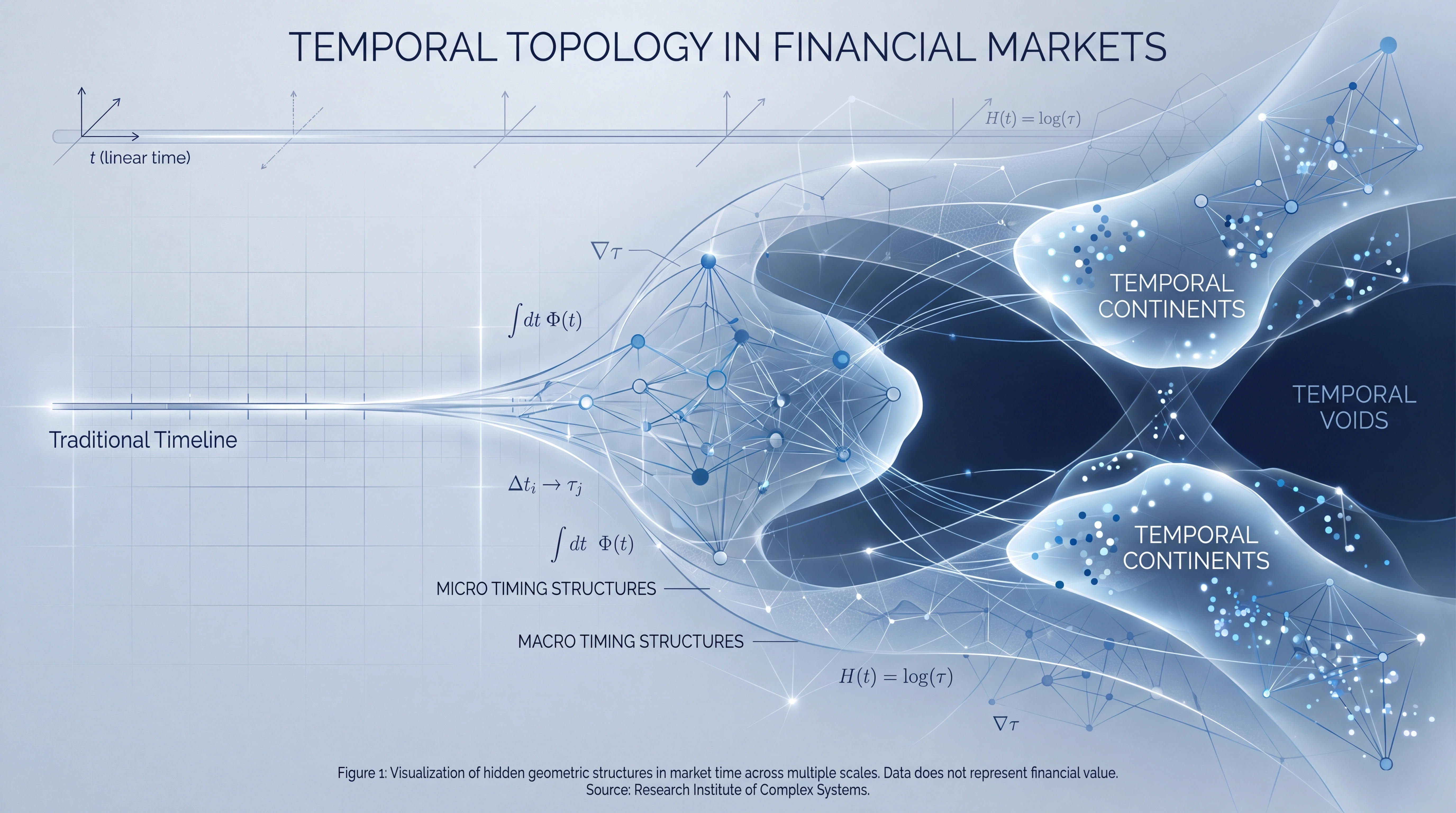
Most trading systems evaluate isolated signals. Our research investigates the environment in which signals exist. Individual timings are treated as elementary observations. The primary research target becomes the distribution of temporal structures rather than the success of individual signals. This approach allows us to investigate: continuous temporal clusters; temporal voids; persistence of temporal density; transition dynamics; interaction between micro and macro temporal structures.
Temporal Cartography
Instead of optimizing indicators, VISTmany constructs an atlas of temporal space. Every timing represents only one point within a much larger structure. The scientific objective is therefore not to optimize isolated events but to describe the topology of the entire temporal environment. The resulting atlas allows researchers to study statistical regularities without introducing theoretical assumptions about market behavior.
Scientific Methodology
The project follows a strict sequence: observation, measurement, statistical verification, falsification. Only after successful falsification may theoretical interpretation begin. This methodology intentionally separates empirical observations from mathematical imagination. No physical analogies are accepted unless they emerge naturally from reproducible measurements.
Conclusion
The transition from isolated trading signals toward temporal cartography represents an important methodological change. Instead of asking, “Does this timing work?”, we ask, “What is the measurable structure of temporal space itself?” Answering this question may eventually provide a new scientific framework for studying financial markets, independent of classical price-centered approaches.
For the core definitions behind this analysis — Temporal Space, Liquidity Activation Point (LAP), and Temporal Spectrum — see the VISTmany Terminology reference page.