From Time Signals to Temporal Space: Why Market Structure Matters More Than Individual Timings
From Individual Signals to an Entire Space
For decades, quantitative finance has focused on one fundamental objective: finding the next trading signal. Researchers traditionally ask: Which indicator works better? Which entry is more accurate? Which pattern produces the highest probability? This approach studies individual events. Our recent investigations suggest that this perspective may be incomplete. Instead of asking where the next signal appears, an alternative question naturally emerges: What if signals are only visible manifestations of a much larger temporal structure?
A Different Research Perspective
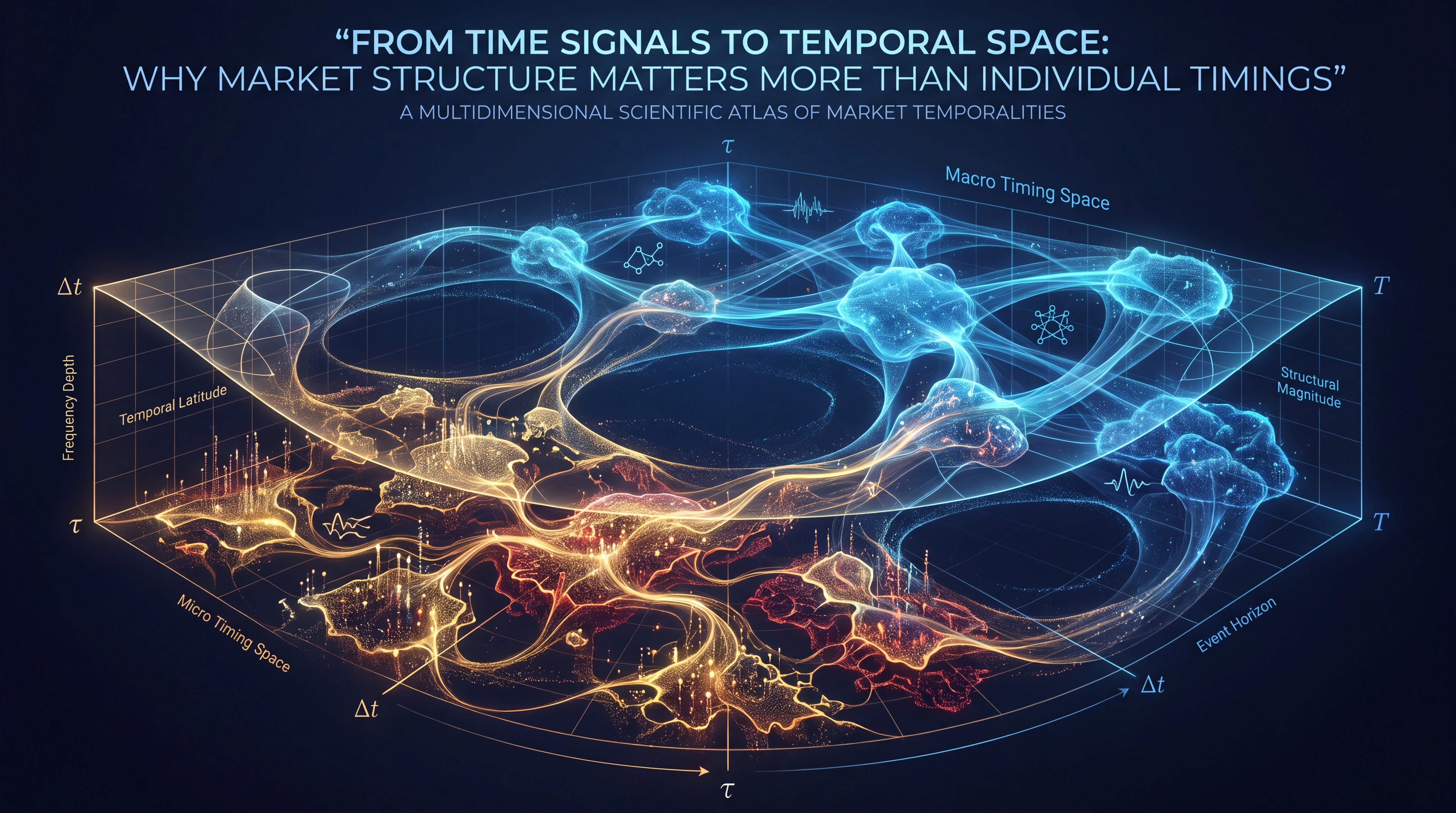
Within the VISTmany Research Laboratory, timing events are no longer considered isolated observations. Instead, every timing is treated as a point inside a much larger temporal environment. The object of study therefore changes completely. Rather than researching: individual timings, isolated cycles, separate market reactions, the research investigates: spatial distributions, density fields, temporal topology, relationships between entire timing systems. The subject becomes time itself, not price.
Two Independent Temporal Universes
Large-scale measurements revealed that market timings naturally separate into two distinct temporal environments. Universe A — Micro Timing Space. Contains short-term timing structures ranging from several minutes up to approximately one hour. These structures evolve rapidly and occupy highly active temporal regions.
Universe B — Macro Timing Space
Contains long-duration timing structures extending over many hours. These regions are significantly more sparse and demonstrate large inactive intervals between clusters. Neither universe dominates the other. Instead, they coexist inside the same temporal axis while preserving their own internal organization.
What the Measurements Revealed
Direct statistical measurements produced several reproducible observations. 1. Temporal space is heterogeneous. Timing clusters do not appear uniformly. Instead, they form islands separated by large temporal gaps. 2. Macro space is mostly empty. Large inactive regions dominate long-duration timing structures. Dense clusters represent only a relatively small fraction of the complete temporal landscape. 3. Micro and Macro systems rarely occupy the same regions. Most micro timings exist inside macro inactive zones. This observation indicates that different temporal scales organize themselves independently rather than recursively. 4. Density evolves continuously. Changes in temporal density occur gradually. Abrupt transitions are extremely rare. The measured transition matrix demonstrates that temporal structures evolve smoothly rather than randomly. 5. Local memory exists. Autocorrelation remains extremely high over short temporal distances before naturally disappearing over longer horizons. This indicates that neighboring regions of temporal space are strongly connected.
Why This Matters
If these observations remain stable across different years, instruments and market regimes, an important implication follows. Markets may possess their own measurable temporal architecture independent of conventional price-based indicators. In such a framework: timings are not the phenomenon. They become measurements of a deeper temporal environment.
Future Research
The next stage of the VISTmany Research Program focuses on understanding the geometry of this temporal environment. Current investigations include: evolution of temporal density, topology of inactive regions, interaction between independent timing universes, persistence of temporal structures, long-term stability of spatial organization. Only after repeated falsification across independent datasets can these observations become scientific laws.
Conclusion
Financial markets may not simply contain isolated timing opportunities. They may contain an organized temporal landscape whose structure exists independently of individual market events. Understanding this landscape could represent a fundamentally different direction for quantitative finance. At VISTmany Research Laboratory, this landscape has become the primary object of investigation.
For the formal definitions of this conceptual framework, see Temporal Space, Temporal Spectrum, and Temporal Density in the VISTmany Terminology page.