The Time Hypothesis: Can Time Be an Independent Variable in Financial Markets?
The Classical Paradigm
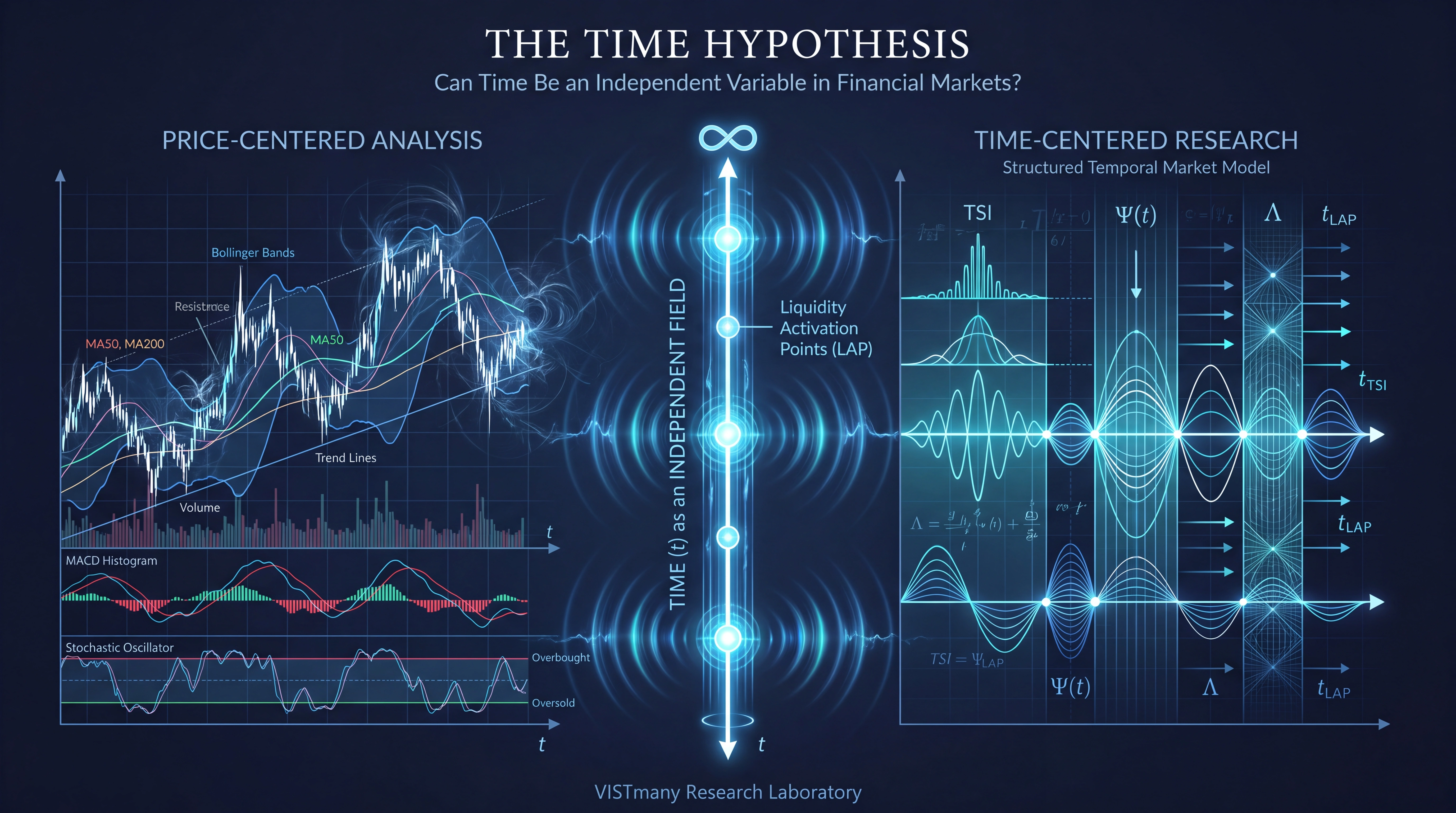
Most existing analytical models begin with price. Technical indicators are calculated from price. Machine learning models are trained using price-derived features. Even volume is interpreted through its relationship with price. In this framework, time is passive. It provides sequence but contributes no information of its own.
A Different Observation
Long-term observation of financial markets suggests that periods of increased market activity frequently appear around recurring temporal structures. These structures often emerge before significant directional movement becomes visible. The observation itself does not constitute proof. However, it raises an important scientific question: Can temporal organization possess measurable informational properties?
The Time Hypothesis
The central hypothesis investigated by VISTmany can be formulated as follows: Financial markets may contain stable temporal structures that exist independently of price and can be identified through quantitative analysis. If correct, this hypothesis implies that time is not merely a coordinate system but an observable component of market dynamics. Such structures would not predict price directly. Instead, they would describe periods during which market conditions become statistically more favorable for directional movement.
Scientific Implications
Treating time as an independent variable fundamentally changes financial analysis. Instead of asking: “Where will price move?” research begins by asking: “When is market structure most likely to change?” Price becomes the consequence. Time becomes the object of investigation.
Research Methodology
Testing this hypothesis requires a multidisciplinary approach combining: mathematical modeling; quantitative finance; computational statistics; software engineering; artificial intelligence; long-term experimental validation. Every proposed temporal model must demonstrate statistical reproducibility before being accepted as part of the research framework.
Limitations
The Time Hypothesis remains an active area of scientific investigation. It should not be interpreted as a universal law of financial markets. Like every scientific hypothesis, it must continuously withstand mathematical verification, statistical testing, and empirical observation.
Future Publications
Subsequent papers will introduce the mathematical concepts developed to investigate temporal market structures, including Liquidity Activation Points (LAP), Timing Strength Index (TSI), temporal synchronization, market morphology, and experimental validation techniques. The objective is not to replace existing market theory but to expand quantitative finance through the systematic study of temporal phenomena.The core concepts used in this hypothesis are defined in the VISTmany Terminology page, including Temporal Space, Liquidity Activation Point (LAP), and Temporal Spectrum.