Temporal Stability: Long-Term Invariance of the VISTmany Temporal Space
Stability as a Scientific Criterion
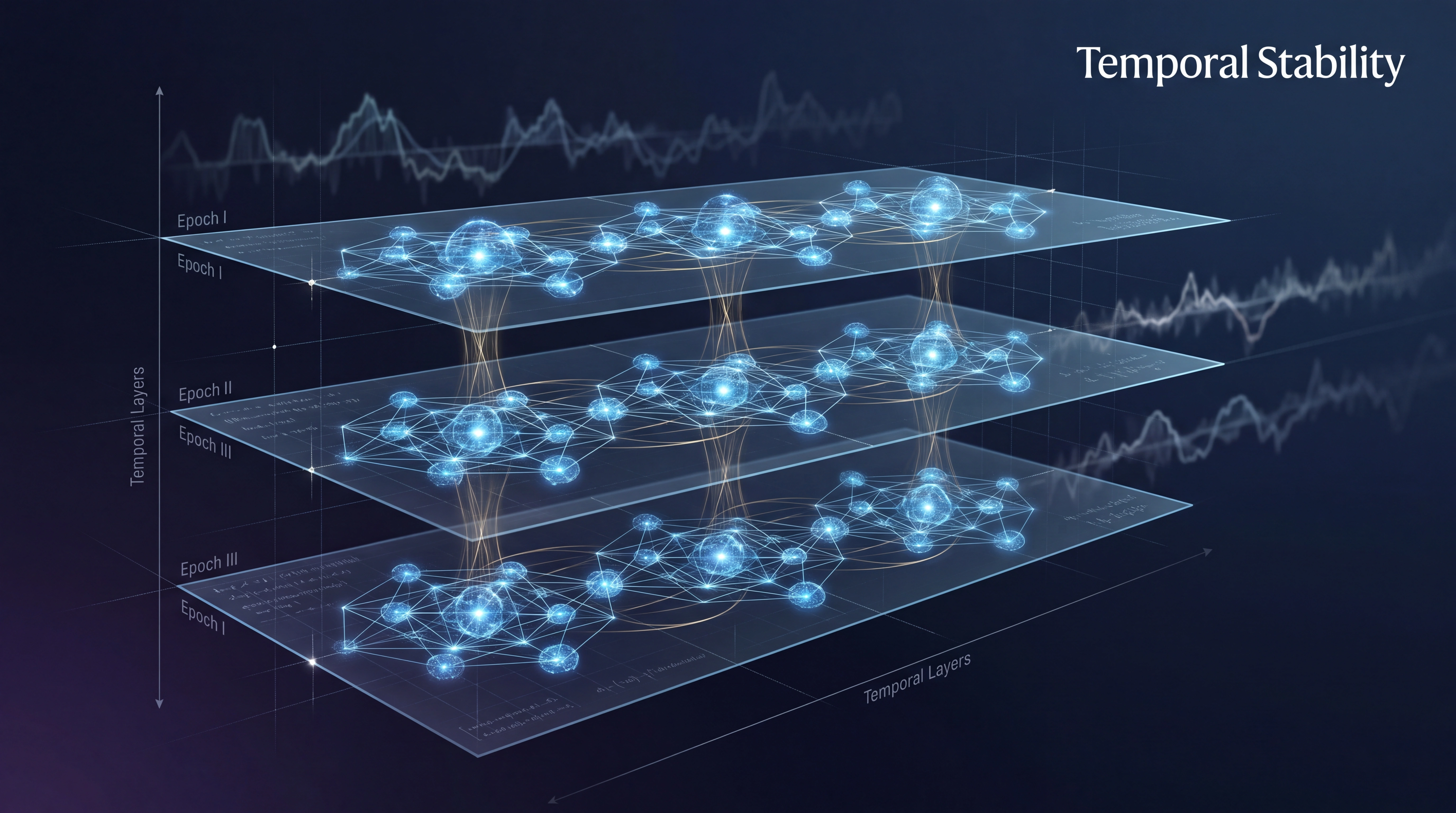
Scientific validity requires reproducibility. If temporal structures represent objective properties of financial systems, they must remain observable under different market regimes. For this reason, every experimental phase within VISTmany evaluates not only predictive efficiency but also structural persistence. The objective is simple: Does Temporal Space preserve its architecture despite changing prices?
Experimental Evidence
Long-term statistical studies performed on historical data from 2020 through 2026 reveal remarkable consistency. Several structural properties remain nearly unchanged throughout the observation period:
- temporal cluster formation;
- persistence of density regions;
- spatial separation between clusters and temporal voids;
- gradual evolution of temporal gradients;
- stable hierarchy between micro and macro timing structures.
Structural Invariance
The observed stability does not imply identical market behavior. Instead, it indicates that the underlying temporal framework evolves according to persistent organizational principles. Financial instruments continue generating different price trajectories while maintaining similar temporal architecture. This distinction is fundamental. Price is dynamic. Temporal structure is comparatively stable.
Scientific Implications
Long-term invariance suggests that Temporal Space behaves as an independent informational layer rather than a by-product of price movement. If future observations continue confirming this stability, Temporal Space may become a measurable characteristic of financial systems comparable to volatility, liquidity, or market participation. Such a framework opens opportunities for developing entirely new classes of temporal financial models.
Conclusion
The central observation is straightforward. Market prices constantly evolve. Temporal architecture demonstrates long-term stability. This difference represents one of the strongest empirical foundations of the VISTmany research program. The stability of Temporal Space provides evidence that time itself may preserve structural information beyond individual market events.