The Temporal Resonance Law: How Independent Time Structures Amplify Market Liquidity
1. Introduction
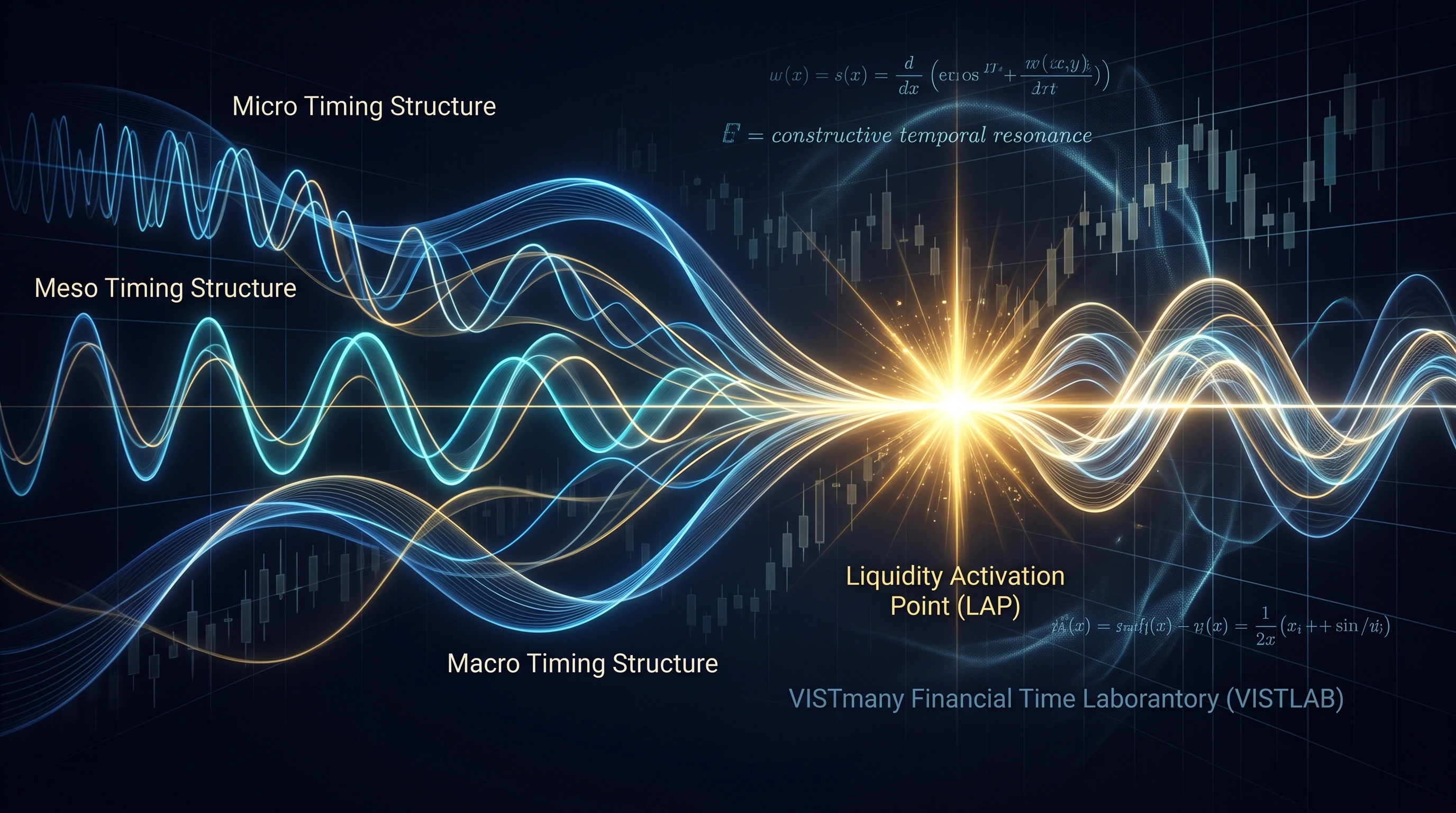
One of the most remarkable observations made during the development of the iVISTscalp5 framework was that not all Liquidity Activation Points possess equal influence. Some isolated LAP events produce only modest market reactions. Others coincide with unusually strong directional movement. The difference could not be explained solely by price action, volatility, trading sessions, or classical market cycles. Instead, repeated observations suggested that multiple temporal structures sometimes converge simultaneously. This phenomenon became known as Temporal Resonance.
2. Independent Temporal Structures
Within the VISTmany framework, market time is represented as multiple interacting temporal spectra rather than a single continuous timeline.
Examples include:
- Micro structures (7 minutes)
- Short structures (15 minutes)
- Intermediate structures (30 minutes)
- Primary structures (60 minutes)
- Extended structures (80 minutes)
- Large structures (100 minutes)
3. Temporal Resonance
The proposed law can be formulated as follows: When two or more independent temporal structures activate simultaneously, the resulting liquidity activation becomes significantly stronger than the contribution of each individual structure. Unlike traditional technical indicators, resonance is not created by price agreement. It is created by time agreement. Multiple temporal frequencies reach constructive synchronization.
4. Constructive and Destructive Resonance
Temporal Space appears capable of exhibiting two distinct behaviors.
Constructive Resonance
Several timing structures activate during nearly the same temporal window.
Observed effects include:
- stronger directional movement;
- higher probability of continuation;
- increased stability of projected timing windows.
Independent structures partially cancel one another.
Observed effects include:
- increased market indecision;
- reduced directional persistence;
- noisy intraday behavior.
5. Practical Trading Implications
For traders, the Temporal Resonance Law provides a practical interpretation. An isolated 7-minute timing may identify a local liquidity event. However, when the same minute also belongs to:
- a 30-minute timing,
- a 60-minute timing,
- and an 80-minute timing,
6. Relationship with Temporal Density
The previous VISTmany publication introduced the concept of Temporal Density. Temporal Resonance extends that concept. Temporal Density measures the quantity of temporal events. Temporal Resonance measures their synchronization. High density without synchronization may produce chaotic market behavior. High synchronization with moderate density may produce exceptionally efficient market movement.
7. Toward a Physical Interpretation
From an econophysical perspective, Temporal Resonance may represent constructive interference between multiple temporal oscillators governing market liquidity. This interpretation suggests that financial markets possess hidden temporal organization beyond observable price behavior. If confirmed through additional research, Temporal Resonance may become one of the fundamental laws describing Temporal Space.
Conclusion
The Temporal Resonance Law proposes that market timing is not determined solely by isolated Liquidity Activation Points. Instead, independent temporal structures may interact constructively or destructively. The synchronization of multiple timing spectra appears capable of amplifying liquidity activation and increasing market predictability. Future research will investigate quantitative measures of resonance intensity and its relationship with trading performance across different financial instruments.