Temporal Space Is Not Time: Discovery of an Independent Market Coordinate
1. Classical assumption
Traditional finance treats time as Price = f(Time) where Time is considered uniform. Every minute is mathematically identical. Only price changes. This assumption underlies virtually every quantitative model.
2. Experimental contradiction
Our observations demonstrate the opposite. Inside equal chronological intervals the market exhibits dramatically different temporal behavior. For example: one hour may contain no significant temporal activity; another hour may generate hundreds of synchronized timing events. Chronological duration remains identical. Temporal density changes completely. Therefore, chronological time cannot describe market timing.
3. Definition of Temporal Space
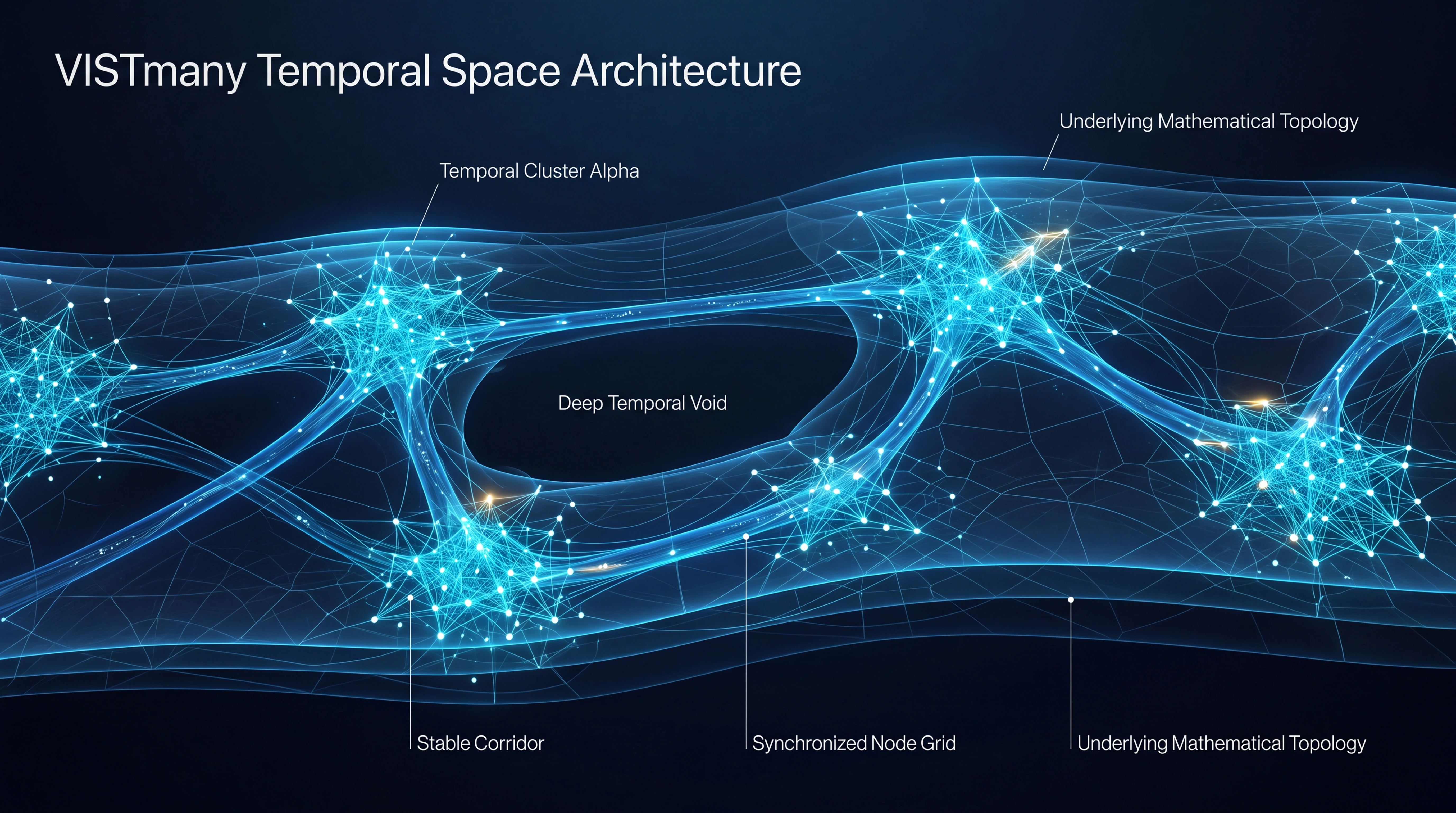
We define Temporal Space as the dynamic distribution of timing density existing inside chronological time. Chronological time answers: “When?” Temporal Space answers: “How active is this moment?” These are different coordinates.
4. Evidence
Across two years of observations we repeatedly measured:
- temporal clustering,
- large temporal voids,
- persistence,
- synchronization,
- density gradients,
- independent macro and micro structures.
5. Physical analogy
A useful analogy is geography. Two cities may be separated by one hundred kilometers. The physical distance is fixed. Population density is not. Likewise, two one-hour periods have identical chronological duration, yet radically different temporal density. The clock remains constant. The temporal landscape changes.
6. Practical implication
This distinction changes trading completely. The objective is no longer to predict price. The objective becomes locating regions of high temporal density. Price movement becomes a consequence rather than the primary observable.
Conclusion
The first fundamental result of the VISTmany project is the separation between chronological time and temporal space. Markets evolve inside chronological time, but timing exists inside temporal space. Understanding this distinction opens an entirely new direction for quantitative market research.
The conceptual definitions for this article are gathered in the VISTmany Terminology page, especially Temporal Space, Temporal Spectrum, and Temporal Density. For the broader research context, see the VISTmany Research Journal.