Temporal Stability: Evidence That Market Time Preserves Its Structure Across Changing Market Conditions
1. Introduction
Every financial market experiences multiple regimes: trending periods, ranging periods, high volatility, low volatility, crisis conditions, recovery phases. Price statistics change dramatically between these environments. If temporal space is only another representation of price, its internal structure should also change. If temporal space is an independent phenomenon, its topology should remain stable. This distinction can be tested experimentally.
2. Experimental Design
The historical database was divided into independent time segments. Each segment was analyzed separately. For every segment the following quantities were measured: cluster-size distribution, temporal void distribution, transition matrix, persistence of temporal states, spatial autocorrelation, synchronization between macro and micro temporal systems. No predictive models were used. Only direct measurements were compared.
3. Experimental Observation
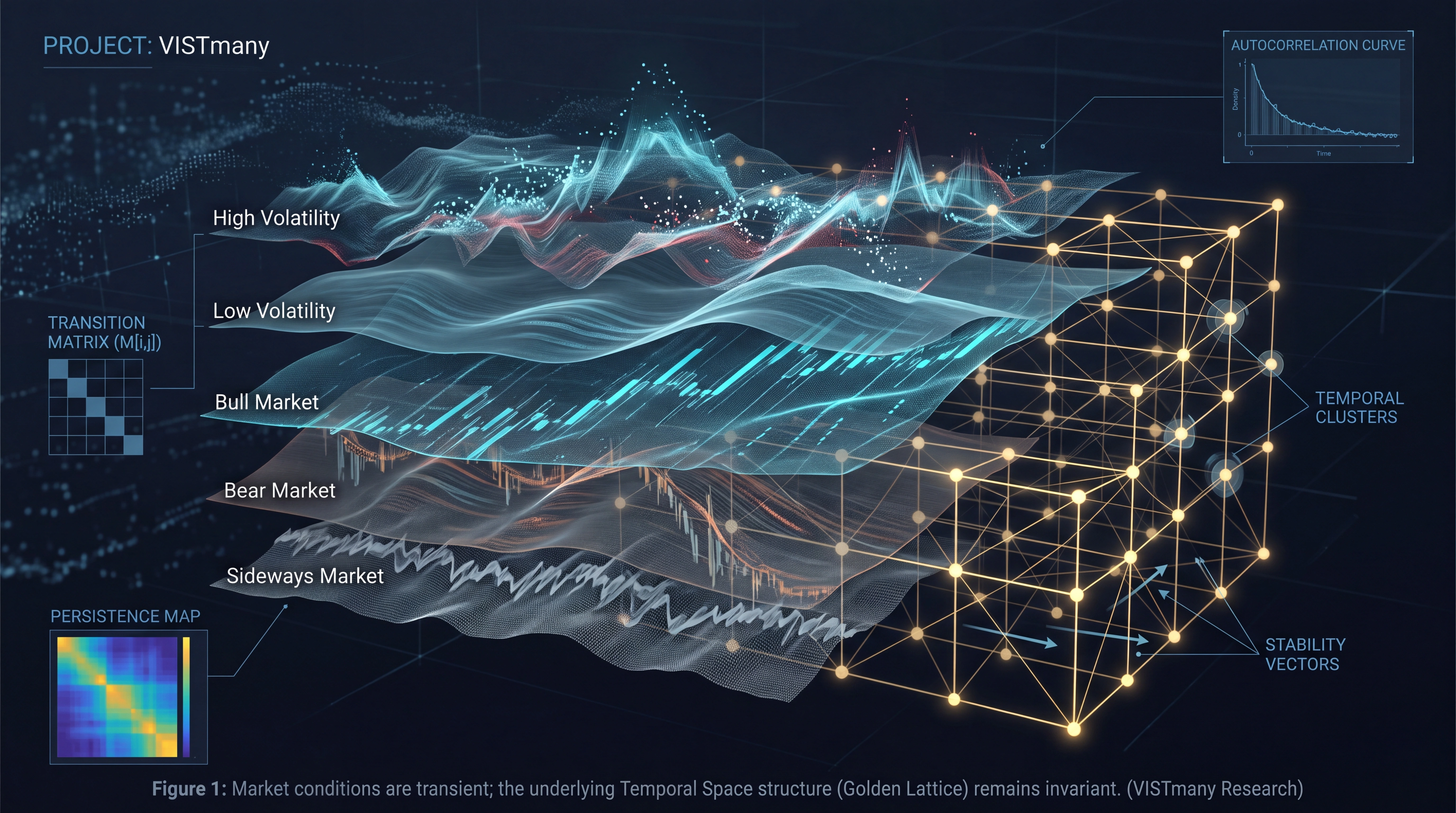
Despite large differences in market volatility, the fundamental temporal architecture remained remarkably stable. The following characteristics consistently reappeared: identical dominant cluster sizes, identical persistence hierarchy, nearly unchanged transition probabilities, preservation of local temporal continuity, stable decay of spatial autocorrelation. Price changed. Time preserved its internal organization.
4. Interpretation
This result suggests an important distinction. Classical indicators measure market state. Temporal geometry measures market structure. A market state may evolve continuously. A market structure appears considerably more stable. Therefore, temporal space behaves more like an invariant coordinate system than a statistical indicator.
5. Scientific Importance
This observation has several consequences. First, it explains why the same temporal algorithms remain effective during different market environments. Second, it reduces dependence on parameter optimization. Third, it suggests that temporal geometry may represent a higher-order organization layer independent of price fluctuations. This hypothesis remains open for further investigation.
Conclusion
Current evidence indicates that market price evolves continuously, while temporal space preserves its statistical architecture over long observation periods. Future research will investigate whether this temporal stability represents one of the fundamental invariants of financial market dynamics.
This idea is closely related to Temporal Space, Temporal Spectrum, and Temporal Density in the VISTmany Terminology reference page.