Why Time Has Been Forgotten in Financial Market Analysis. A Fundamental Research Problem
Price-Centered Thinking
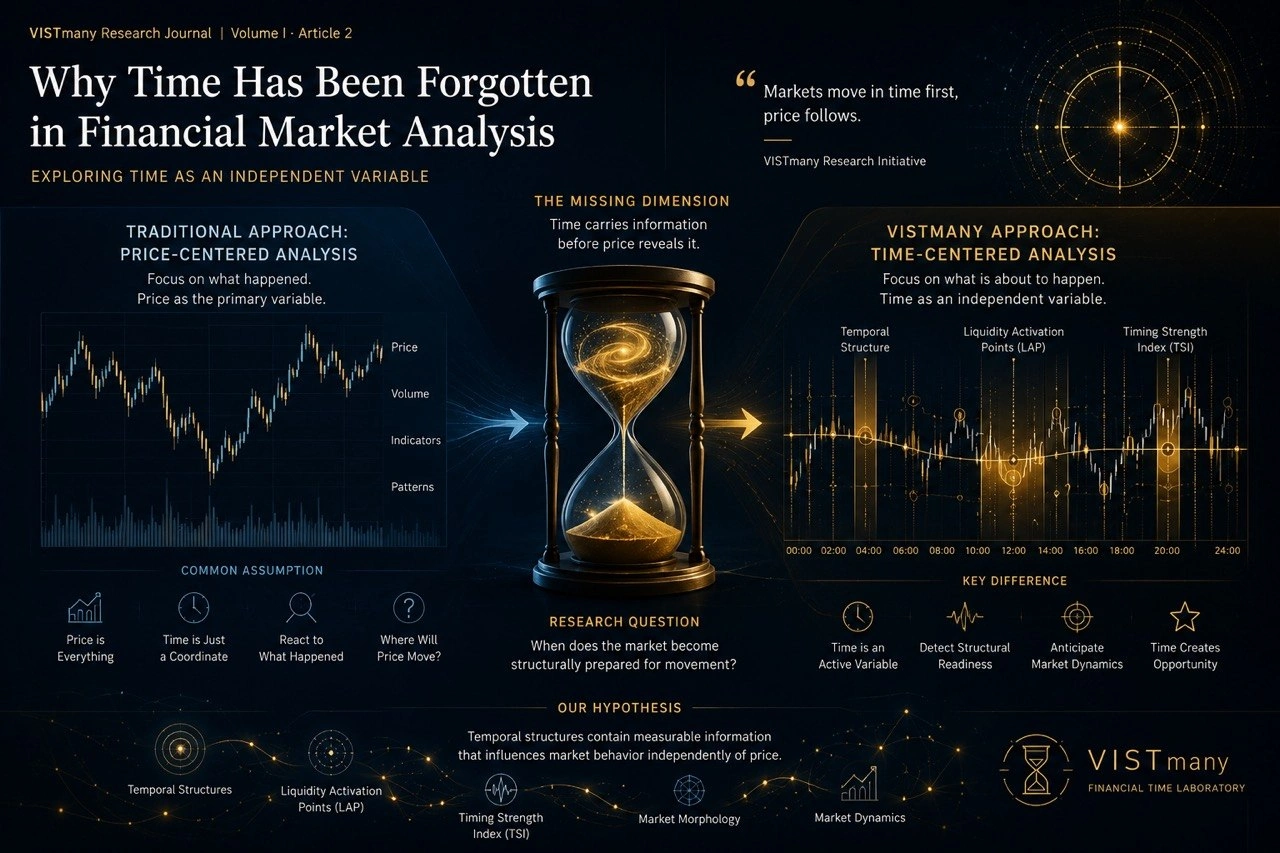
For decades, financial research has focused on identifying relationships between: price and volume, price and volatility, price and momentum, price and statistical distributions. These approaches have produced powerful mathematical models and practical trading systems. However, they all begin with the same assumption: Price is the primary variable. Time serves only as a measurement scale.
The Missing Dimension
Every market event occurs at a specific moment. Every transaction has a timestamp. Every liquidity event is activated in time before it becomes visible through price. Despite this, very few research programs investigate whether temporal organization itself possesses measurable properties. This observation motivated the creation of the VISTmany Research Initiative.
A Different Scientific Question
Rather than asking: “Where will price move?” our research begins with a different question: “When does the market become structurally prepared for movement?” This shift changes the research framework completely. Price becomes an observable consequence. Time becomes the object of investigation.
A Time as an Independent Variable
Within classical physics, independent variables describe the evolution of systems. In financial markets, time has traditionally been considered merely the axis along which price evolves. The VISTmany hypothesis proposes a different interpretation. Temporal structures may represent independent informational patterns capable of influencing market behavior before significant price movement develops. This hypothesis remains under continuous mathematical and experimental investigation.
Scientific Responsibility
The purpose of this journal is not to promote a new belief system. Scientific hypotheses require evidence. Every proposed concept must be supported by: mathematical consistency; statistical significance; experimental reproducibility. Only through this process can temporal analysis become a legitimate scientific discipline within quantitative finance.
Future Research
Subsequent publications will introduce the mathematical concepts developed by the VISTmany Research Laboratory, including temporal structures, Liquidity Activation Points (LAP), Timing Strength Index (TSI), market morphology, and quantitative validation methods. Our objective is not to replace existing financial theory. Our objective is to expand it by introducing time as an active research dimension.The terminology behind this discussion is formalized in the VISTmany Terminology page, especially Temporal Space, Liquidity Activation Point (LAP), and Temporal Density.