 iVISTscalp5 Indicator
What Is iVISTscalp5?
One-Week-Ahead Forecast
iVISTscalp5 calculates market timings up to one week in advance.
This means that the trader does not need to continuously search the market for possible entry moments. The temporal forecast is calculated beforehand and provides a structured view of the upcoming trading week.
For each forecasted timing, iVISTscalp5 can provide:
WHEN → DIRECTION → EXPECTED MOVEMENT
The trader can therefore know in advance:
- when a potential market activation may occur;
- the forecast direction — BUY or SELL;
- the expected movement associated with the timing.
The forecast is available before the future market movement takes place.
This makes iVISTscalp5 fundamentally different from indicators that generate signals only after analysing already formed price data.
The one-week-ahead forecast is not an instruction to trade every timing. It is a forward-looking temporal map of potential market activity that allows the trader to plan attention, observation and execution in advance.
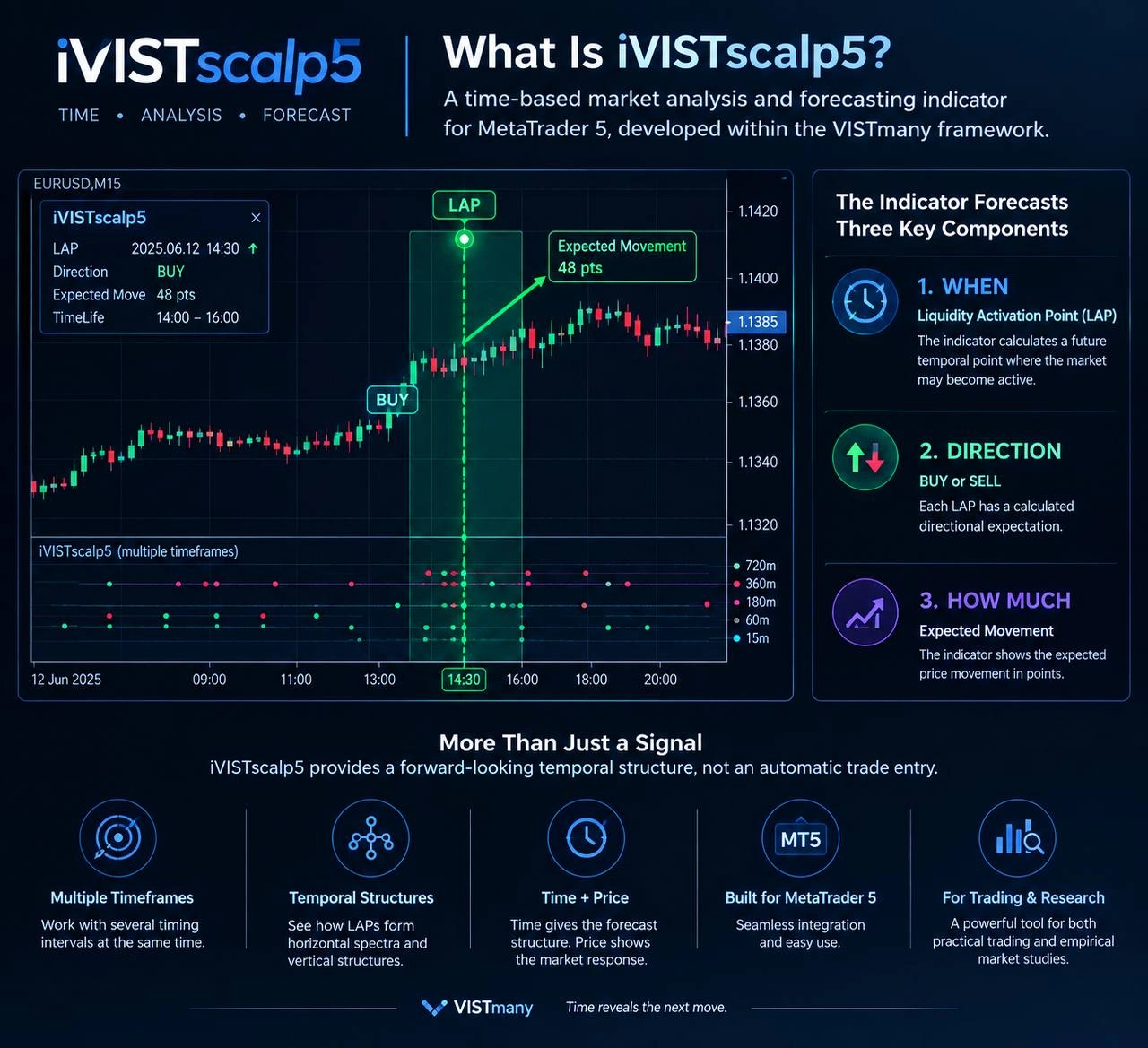
iVISTscalp5 is a time-based market analysis and forecasting indicator for MetaTrader 5, developed within the VISTmany research framework.
Unlike conventional indicators that primarily analyze past price behaviour, iVISTscalp5 is designed to work with future calculated temporal structures.
The indicator provides three main forecast components:
- WHEN — the calculated future timing of potential market activation;
- DIRECTION — the forecast direction: BUY or SELL;
- EXPECTED MOVEMENT — the calculated expected price movement in points.
The central forecasting object is the Liquidity Activation Point (LAP) — a calculated future temporal point associated with potential market activation.
iVISTscalp5 can display multiple timing intervals simultaneously, allowing traders and researchers to observe how different temporal scales interact.
The indicator combines Time and Price:
Time provides the forecast structure.
Price provides the market response and execution context.
Therefore, an iVISTscalp5 timing is not an automatic trade entry. It identifies a calculated period when the market may become active and gives the trader a framework for observing and evaluating the resulting price behaviour.
iVISTscalp5 is designed for both practical trading and empirical research of financial-market behaviour through time.
How iVISTscalp5 Works
One-Week-Ahead Forecast
iVISTscalp5 calculates market timings up to one week in advance.
The forecast is calculated before the future market movement takes place. This allows the trader to see the temporal structure of the upcoming trading week in advance rather than continuously searching the chart for possible entry moments.
For each forecasted timing, the indicator provides three key parameters:
WHEN → DIRECTION → EXPECTED MOVEMENT
This means that before the market reaches the forecasted timing, the trader already knows:
- WHEN a potential market activation may occur;
- DIRECTION — BUY or SELL;
- EXPECTED MOVEMENT associated with the timing.
The forecast then becomes the starting point for observation and analysis: when the LAP approaches, the trader observes the price reaction and determines whether the current market conditions provide a valid trading opportunity.
The one-week-ahead forecast does not mean that every timing must be traded. It provides a forward-looking temporal map of potential market activity, allowing attention, observation and execution to be planned in advance.
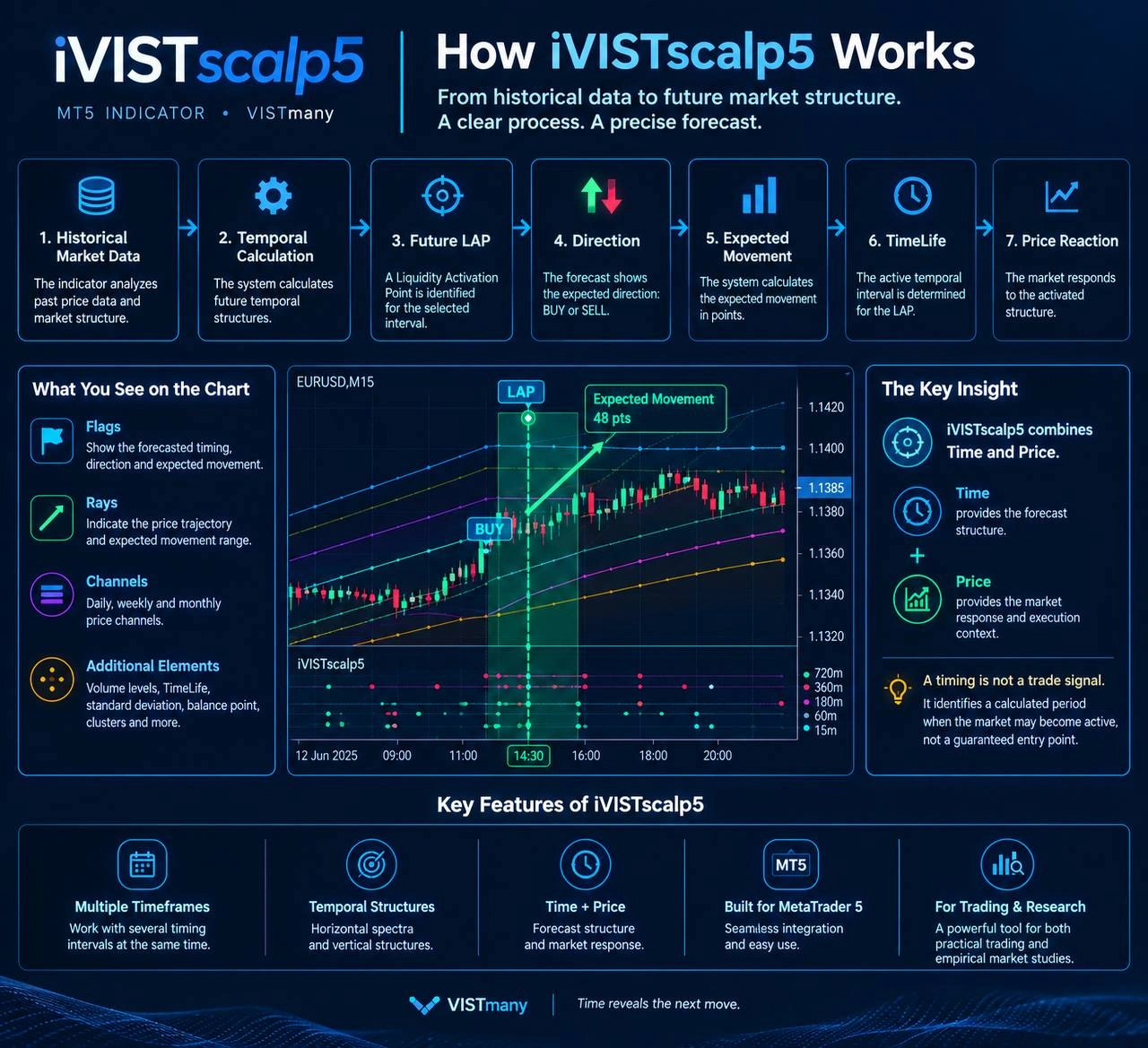
iVISTscalp5 calculates future temporal structures using historical market data and the selected timing parameters.
The basic process is:
Historical Market Data → Temporal Calculation → Future LAP → Direction → Expected Movement → TimeLife → Price Reaction
For each calculated LAP, the system determines:
- the future timing;
- the timing interval;
- the forecast direction;
- the expected movement in points;
- the active TimeLife period.
TimeLife represents the active temporal interval associated with a LAP. Its basic boundary is determined by the LAP time and the selected timing interval.
Different timing durations represent different temporal scales. Shorter intervals can provide a more local view of potential activation, while larger intervals can describe broader temporal structures and longer-lasting market states.
When several LAPs occur close together, they can form temporal structures such as Horizontal Temporal Spectra and Vertical Temporal Structures. These structures allow the market to be studied not only through individual timings, but through their concentration, interaction and evolution.
The indicator therefore does not simply generate isolated BUY/SELL markers.
It creates a forward-looking temporal framework in which individual LAPs can be studied together with their surrounding temporal structure and subsequent price reaction.
What Does the Indicator Forecast?
One-Week-Ahead Forecast
iVISTscalp5 calculates market timings up to one week in advance.
The forecast is generated before the corresponding market movement takes place, providing a structured view of potential market activity throughout the upcoming trading week.
For each forecasted timing, iVISTscalp5 provides three key elements:
WHEN → DIRECTION → EXPECTED MOVEMENT
This means the trader can know in advance:
- WHEN a potential market activation may occur;
- DIRECTION — BUY or SELL;
- EXPECTED MOVEMENT associated with the forecasted timing.
The forecast therefore provides more than a point on the future time axis. It gives the trader a predefined temporal framework for the coming week, helping determine when to pay attention to the market and what type of movement to observe.
When the forecasted timing approaches, the actual price reaction can be observed and evaluated in its current market context.
The one-week-ahead forecast is not a command to enter every timing. It is a forward-looking map that allows the trader to plan attention, observation and potential execution before the future market movement occurs.
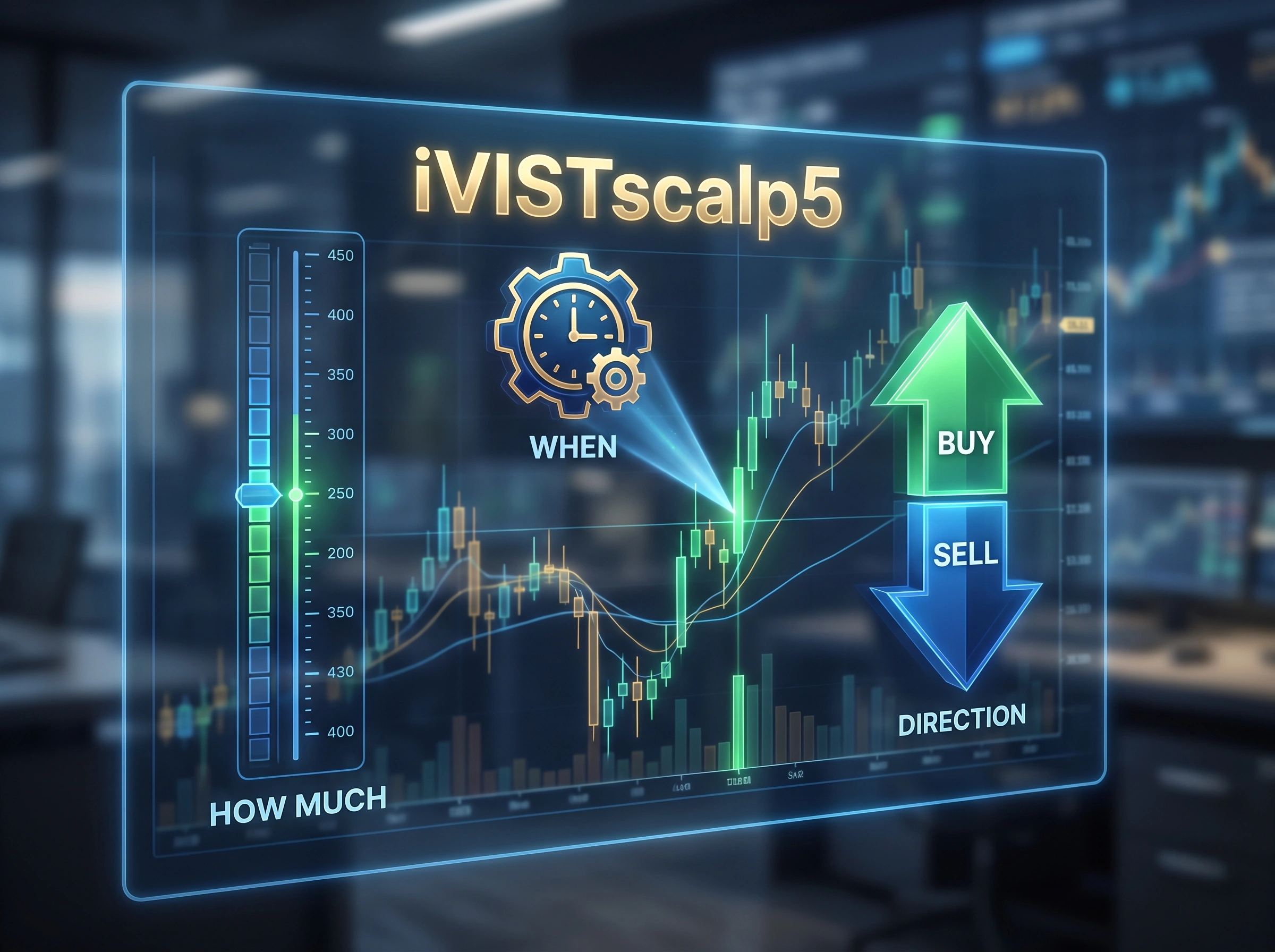
iVISTscalp5 forecasts three primary characteristics of a future market event:
1. WHEN
The indicator calculates a future Liquidity Activation Point (LAP) — a temporal coordinate where market activation may occur.
2. DIRECTION
Each LAP has a calculated direction expectation:
BUY or SELL.
Direction describes the expected side of the subsequent market movement associated with the LAP.
3. HOW MUCH
Each LAP also has an Expected Movement measured in points.
This represents the calculated scale of the directional movement associated with that temporal structure.
These three components should always be considered separately:
WHEN ≠ DIRECTION ≠ HOW MUCH
A timing can be useful for studying when a reaction begins without necessarily producing the full expected movement.
This distinction is important for both trading and research. VISTmany research separates activation, speed of movement, maximum favourable excursion (MFE), maximum adverse excursion (MAE), directional persistence and full achievement of the expected movement rather than treating them as one measurement.
The purpose of iVISTscalp5 is therefore not to replace market analysis with a single signal.
It provides a pre-calculated temporal forecast that allows the trader to know in advance when to pay attention, which direction is expected, and what movement scale is associated with the forecast.
LAP — Liquidity Activation Points
A Liquidity Activation Point (LAP) is the central forecasting object used by iVISTscalp5.
A LAP is a calculated future temporal point associated with a potential activation of market movement.
For each LAP, iVISTscalp5 provides:
- Time — when the forecasted temporal event occurs;
- Direction — BUY or SELL;
- Expected Movement — the calculated movement associated with the LAP;
- TimeLife — the active temporal interval following the LAP.
The LAP is calculated from historical market data and the selected timing parameters. The future market price is not required to calculate the forecast.

LAP is not an automatic entry
A LAP identifies a time window for market observation. It does not guarantee that price will immediately move in the forecast direction or reach the full expected movement.
The trader observes the market reaction around the LAP and combines the temporal forecast with the current price structure.
This creates the basic VISTmany sequence:
Future LAP → Market Activation → Price Reaction → Movement
LAPs can also interact with other LAPs from the same or different timing intervals. When several temporal events become concentrated in time, they may form larger temporal structures such as Temporal Spectra, Temporal Density and multi-scale alignment.
This makes the LAP more than an isolated signal: it is a coordinate within the broader Temporal Space studied by the VISTmany methodology.
How to Read the iVISTscalp5 Indicator
iVISTscalp5 is designed to make future temporal forecasts visible directly on an MT5 chart.
The most important elements are the Flags, Rays, timing information and price structure.

Flags
Flags identify calculated timing events on the chart.
A flag can provide information about:
- the forecasted time;
- BUY or SELL direction;
- the timing interval;
- expected movement.
The flag therefore answers the first practical question:
When should I pay attention to the market?
Rays
Rays provide a visual representation of the forecasted movement associated with a timing structure.
They help connect the temporal forecast with the price chart and make it easier to observe how price behaves after the forecasted timing becomes active.
Timing Duration
The timing interval defines the temporal scale being studied.
For example:
7 minutes → local timing
60 minutes → broader timing structure
Larger timing durations can describe broader and longer-lasting temporal structures.
TimeLife
TimeLife defines the active temporal period associated with a LAP.
It allows the trader to distinguish between:
before activation → active TimeLife → after TimeLife
The end of TimeLife should not automatically be interpreted as a reversal or continuation signal. Research conducted within the VISTmany framework shows that the end of TimeLife is not, by itself, a reliable directional trigger.
Expected Movement
Expected Movement represents the calculated scale of the forecasted directional movement.
It should not be interpreted as a guaranteed target.
A larger expected movement can be associated with larger favourable and adverse price excursions. Therefore, expected points should always be interpreted together with timing duration and the surrounding temporal structure.
The main rule
Do not read one visual element in isolation.
The useful information comes from the interaction between:
Time + Direction + Expected Movement + TimeLife + Temporal Structure + Price
Time + Price Analysis
The central practical principle of iVISTscalp5 is the interaction between Time and Price.
The indicator does not treat time and price as competing sources of information.
Instead:
Time provides the forecast structure.
Price provides the response and execution context.
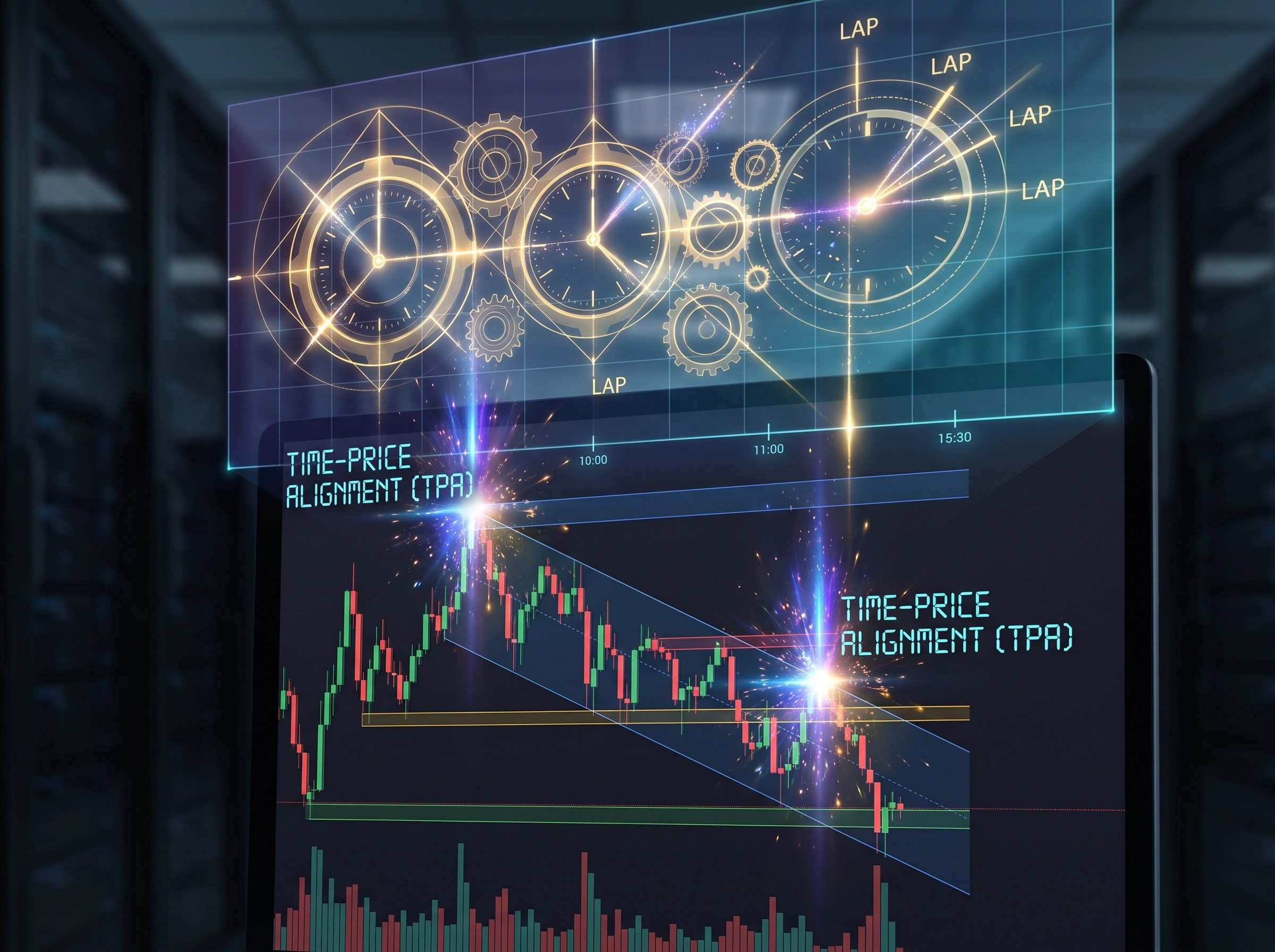
The Temporal Layer
The temporal layer contains:
- future LAPs;
- timing intervals;
- direction;
- Expected Movement;
- TimeLife;
- Temporal Spectra;
- Temporal Density;
- multi-scale alignment and divergence.
This layer answers:
When may the market become active?
The Price Layer
The price layer contains the current market position and price structures displayed by iVISTscalp5.
These may include:
- daily, weekly and monthly price channels;
- principal price levels;
- volume accumulation levels;
- balance structures;
- standard-deviation boundaries;
- the current position of price relative to the forecast.
This layer answers:
How is price responding to the temporal structure?
Time–Price Alignment
A temporal event becomes more informative when it is studied together with relevant price structure.
This relationship is described within VISTmany as Time–Price Alignment (TPA).
A simplified analytical sequence is:
LAP → Price Position → Activation → Reaction → Movement
The same LAP can therefore produce different trading situations depending on where price is located when the timing becomes active.
Important distinction
iVISTscalp5 does not eliminate the need for price analysis.
It changes the order of attention:
First identify the temporal opportunity.
Then study the price response.
This allows the trader to observe price around a predefined future temporal structure instead of continuously searching the chart for possible entry points.
Trading Models
iVISTscalp5 can be used with different trading approaches. The indicator does not require every calculated LAP to become a trade.
The following models represent practical ways to study and use the relationship between timing and price.
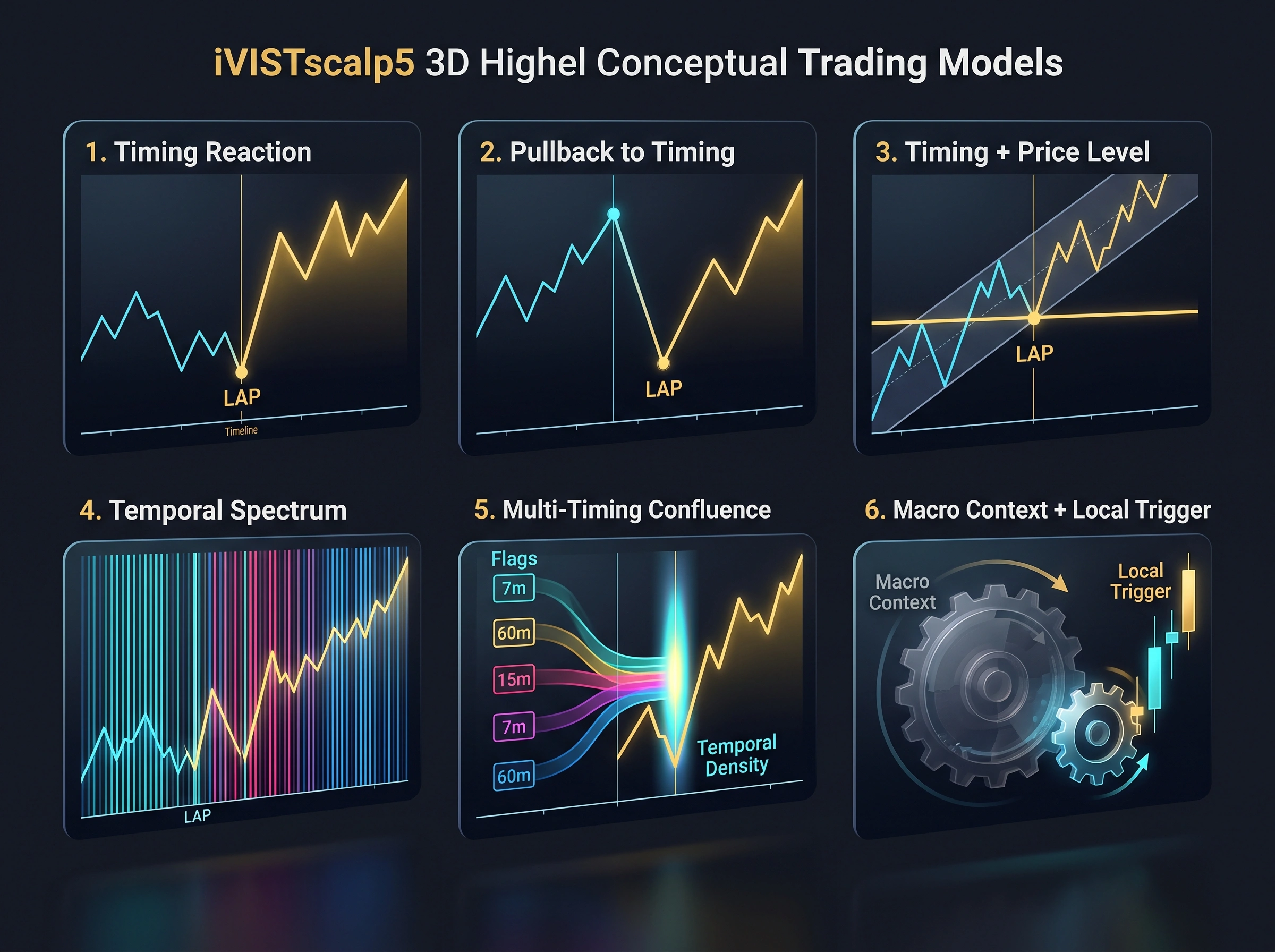
Model 1 — Timing Reaction
LAP → Reaction → Entry
The trader waits for the forecasted timing and observes whether price begins to react in the expected direction.
This model is particularly suitable for shorter timing intervals.
Model 2 — Pullback to Timing
If price has already moved strongly in the forecast direction before the LAP, entering immediately may mean chasing the movement.
Instead:
Pre-move → LAP → Pullback → Reaction
The trader waits for price to return toward a relevant timing or price reference before considering an entry.
Model 3 — Timing + Price Level
The trader combines a future LAP with a relevant price level.
Examples include:
- LAP + channel boundary
- LAP + principal price level
- LAP + volume level
The purpose is to study whether market activation and price location create a meaningful Time–Price Alignment.
Model 4 — Temporal Spectrum
Instead of treating every nearby LAP as an independent signal, the trader studies the entire Temporal Spectrum.
First LAP → Spectrum → Activation → Reaction → Movement
The position of the LAP inside the spectrum can matter. Research shows that individual LAPs and spectrum boundaries often react faster than the middle of long spectra.
Model 5 — Multi-Timing Confluence
Several timing intervals can be displayed simultaneously.
For example:
60m + 48m + 15m + 7m
When their LAPs become concentrated in the same temporal region, the trader can study the resulting Temporal Density and directional alignment.
Model 6 — Macro Context + Local Trigger
Larger timing intervals can provide broader temporal context, while shorter intervals can provide more precise local information.
A working research model is:
Macro Temporal Field → Central Synchronization → Local Activation → Price Reaction
This should be treated as a research-based working model, not as a rigid universal sequence.
The essential rule
A calculated timing creates an observation opportunity — not an obligation to trade.
The final decision remains dependent on market context, price behaviour, risk management and the trader’s execution rules.
How to Use iVISTscalp5 in MetaTrader 5
iVISTscalp5 is designed specifically for MetaTrader 5 (MT5).
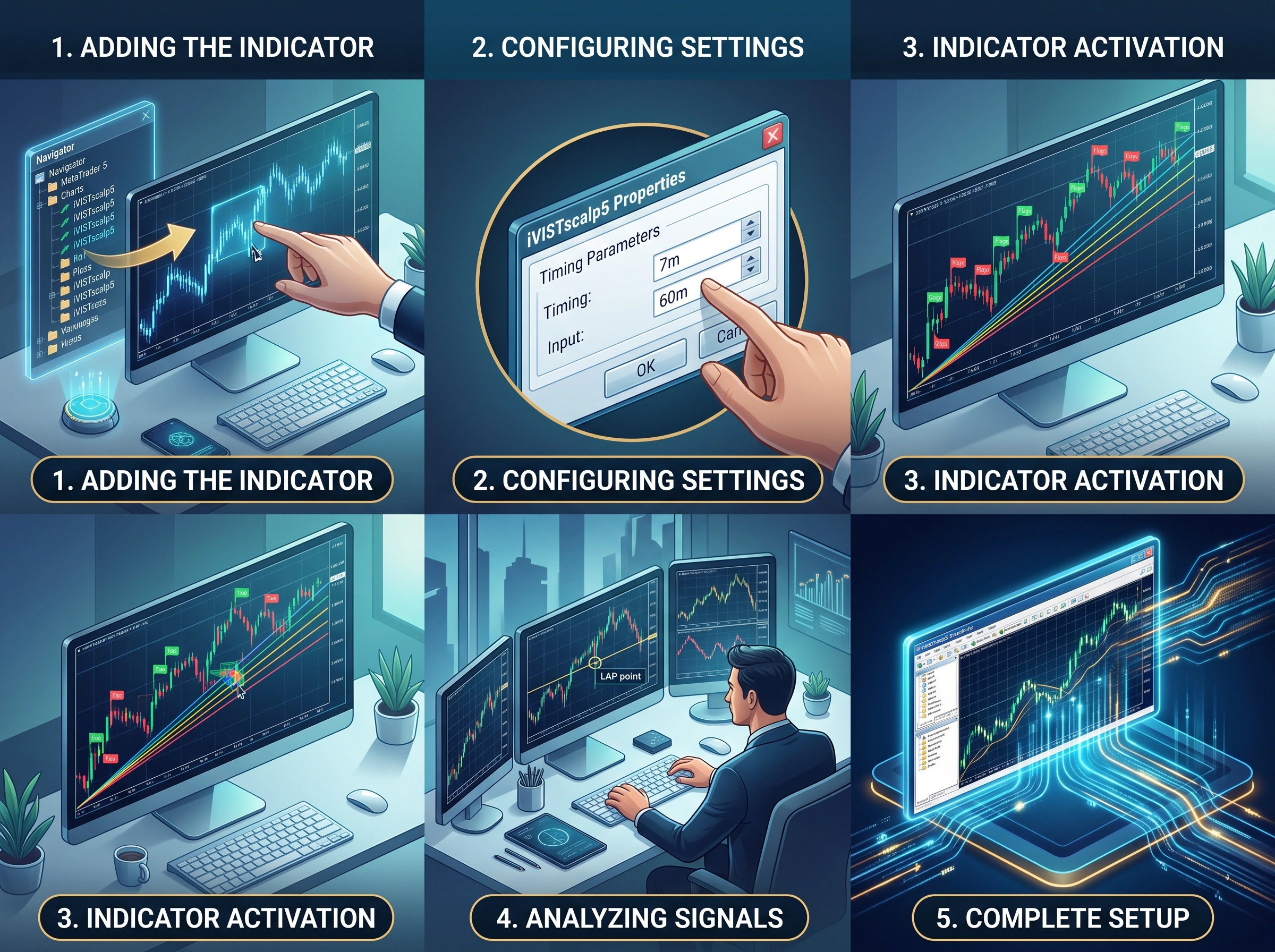
Step 1 — Install the Indicator
Install iVISTscalp5 through the official MQL5 Market.
After installation, open MetaTrader 5 and locate the indicator in the Navigator window.
Step 2 — Prepare the Chart
Open the financial instrument you want to study and select the required timeframe. For detailed timing research, lower chart timeframes can be used to observe the market reaction around calculated LAPs.
Step 3 — Add iVISTscalp5 to the Chart
Drag the indicator from the Navigator onto the chart.
The indicator will calculate and display its temporal forecast together with the selected price structures.
Step 4 — Select Timing Parameters
Choose the timing duration and historical calculation parameters.
The timing duration determines the temporal scale being studied.
Different durations can be used simultaneously by adding additional instances of iVISTscalp5 to the same chart.
Step 5 — Read the Forecast
For each timing structure, identify:
Time → Direction → Expected Movement → TimeLife
Then examine the current price position and surrounding price structure.
Step 6 — Observe the Market Reaction
When the forecasted LAP approaches, do not automatically enter the market.
Observe:
- whether price reacts;
- whether the reaction follows the forecast direction;
- whether price has already moved before the LAP;
- whether other timing structures are aligned or opposed;
- where price is located relative to important price structures.
Step 7 — Decide Whether to Trade
The indicator provides a temporal forecast.
The trader decides whether the current market context provides a suitable trading opportunity.
Recommended starting approach
New users should begin with a small number of timing intervals rather than immediately displaying many temporal scales.
A simple starting configuration can be:
7-minute + 60-minute
After understanding these structures, additional timing intervals can be introduced for multi-scale analysis and research.
MT5 as a Research Environment
MetaTrader 5 can also be used to investigate iVISTscalp5 systematically through historical data and the Strategy Tester.
This allows the same temporal structures to be studied across different instruments, periods and market conditions.
Researching the Influence of Time on Financial Markets
iVISTscalp5 can be used not only for trading, but also as an instrument for empirical research into the role of time in financial markets.
The objective is not simply to ask whether a timing was followed by a price movement.
A deeper research question is:
How does market behaviour change when different temporal structures become active?

1. Define the Research Question
Before examining the results, define:
- the timing interval;
- the historical period;
- the primary metric;
- the control condition;
- the definition of a successful event.
The definition should not be changed after seeing the results.
2. Calculate the Future LAP
The LAP, direction and Expected Movement must be determined without using future price information from the period being tested.
This preserves the distinction between:
Forecast → Observation → Result
3. Record Every Event
A research dataset can include:
- LAP time;
- timing duration;
- direction;
- Expected Movement;
- Energy;
- TimeLife;
- MFE;
- MAE;
- 25%, 50% and 100% movement levels;
- directional persistence;
- start-price test;
- adverse movement;
- weekday and calendar regime.
4. Study Temporal Structures
Individual LAPs should not be studied in isolation.
Research can examine:
- Horizontal Temporal Spectra;
- Vertical Temporal Structures;
- Temporal Density;
- Alignment;
- Divergence;
- Temporal Gaps;
- Energy evolution;
- Expected Points evolution.
The structure itself should be defined independently of the subsequent price result.
5. Separate WHEN from HOW MUCH
This is one of the most important principles of VISTmany research.
WHEN includes:
- activation;
- reaction start;
- speed;
- timing position.
HOW MUCH includes:
- MFE;
- MAE;
- Expected Movement;
- full target achievement.
A condition can accelerate a market reaction without necessarily increasing the probability of reaching the full expected movement.
6. Use Discovery and Holdout Periods
A robust research design separates periods used to discover patterns from periods used to test them. A current VISTmany research protocol uses:
2020–2024 → Discovery
2025–2026 → Holdout
The holdout period should not be optimized after observing its results.
7. Use Matched Controls When Necessary
When a specific temporal effect needs to be separated from normal market activity, matched controls can be used.
Depending on the research question, controls can be matched by:
- timing duration;
- year;
- weekday;
- time of day;
- Expected Movement;
- direction.
8. Test Robustness
A potential temporal effect should be checked across different:
- years;
- market regimes;
- instruments;
- time intervals;
- BUY/SELL directions;
- calendar conditions.
A result that appears only in one narrow configuration should be treated as a candidate rather than a general rule.
9. Record Negative Results
A hypothesis that does not survive testing is still a research result.
VISTmany therefore distinguishes between:
Confirmed findings → Working candidates → Exploratory hypotheses
This prevents statistical observations from being presented as universal laws.
The Research Principle
The purpose of temporal research is not to find one perfect timing.
It is to understand how future temporal structure, market activation and price response interact.
The working research chain is:
Future Temporal Forecast → LAP → Temporal Structure → Market Activation → Price Response → Measured Outcome
This turns the MT5 chart into a laboratory for studying the relationship between Time and Price.
iVISTscalp5 in the VISTmany Framework
iVISTscalp5 is the principal practical and computational implementation of the VISTmany methodology for MetaTrader 5.
VISTmany studies financial markets through the interaction of Time and Price.
The methodology is organized around several connected layers:
VISTmany → TLV → LAP → Temporal Structure → Time + Price → Market Reaction

VISTmany
VISTmany is the research framework for studying financial-market behaviour through time, temporal structures, price structure and their interaction.
Its central principle is:
Time is the signal. Price is the reaction.
TLV — Time Language VISTmany
TLV (Time Language VISTmany) is the conceptual language used to describe the temporal structures identified in the research.
It provides a common terminology for concepts such as:
- LAP;
- Timing;
- TimeLife;
- Temporal Spectrum;
- Temporal Density;
- Temporal Energy;
- Temporal Gap;
- Market Activation;
- Time–Price Alignment.
LAP — Liquidity Activation Point
LAP is the central computational object of the temporal forecast.
It represents a calculated future temporal coordinate associated with potential market activation.
iVISTscalp5 makes these calculated temporal structures visible and usable directly in MT5.
iVISTscalp5
iVISTscalp5 connects the VISTmany methodology with practical market analysis.
It provides:
Future Timing + Direction + Expected Movement + TimeLife + Price Structure
This allows the same framework to be used for both:
- practical trading;
- systematic market research.
VISTLAB
VISTLAB extends the VISTmany approach into a web-based research environment.
While iVISTscalp5 is designed for MetaTrader 5, VISTLAB provides an online environment for observing and studying temporal market structures.
Research
The research layer examines what happens when calculated temporal structures become active.
This includes the study of:
- market activation;
- price reaction;
- movement magnitude;
- MFE and MAE;
- directional persistence;
- temporal spectra;
- density;
- alignment and divergence;
- energy evolution;
- temporal gaps.
The purpose is not to turn every observation into a trading rule.
The purpose is to determine which temporal structures are stable, which are conditional, and which require further research.
One Framework — Different Layers
The relationship can therefore be summarized as:
VISTmany
Research framework
↓
TLV
Language and terminology
↓
LAP
Computational temporal object
↓
iVISTscalp5
MT5 implementation
↓
VISTLAB
Online research environment
↓
Empirical Research
Measurement and validation
iVISTscalp5 is therefore not an isolated indicator. It is the practical interface through which the VISTmany temporal framework can be observed, applied and investigated directly in the financial market.
The indicator is the instrument.
The methodology is the framework.
The research is the laboratory.
Research & Real Forecast Examples: iVISTscalp5
Continue the research: use the iVISTscalp5 FAQ for practical answers and the VISTmany terminology for definitions of LAP, TimeLife, Temporal Spectrum and Time + Price concepts.
Official indicator: iVISTscalp5 on the MQL5 Market.
How iVISTscalp5 Is Observed in Real Market Conditions
iVISTscalp5 is not designed only to display historical market information.
Its fundamental feature is that it calculates future market timings in advance, up to one week ahead. These forecasts create a predefined temporal framework that can then be observed as the market develops.
This makes it possible to separate two stages:
FORECAST → OBSERVATION
The forecast exists first.
The market reaction comes later.
This distinction is fundamental to understanding the practical use of iVISTscalp5.
One-Week-Ahead Forecast
iVISTscalp5 calculates market timings up to one week in advance.
For each forecasted timing, the indicator provides:
WHEN → DIRECTION → EXPECTED MOVEMENT
The trader therefore does not have to continuously search the market for every possible opportunity.
The temporal forecast is already calculated.
When a forecasted timing approaches, the trader can check the current market situation, observe the price reaction and decide whether an order should be opened.
The forecast is therefore a framework for attention and observation, not an instruction to trade every timing.
From a Calculated Timing to a Real Market Reaction
The practical research process can be described as:
Future Temporal Forecast
↓
LAP
↓
Forecasted Direction & Expected Movement
↓
Market Reaches the Timing
↓
Price Reaction
↓
Observed Movement
The indicator provides the first part of this sequence in advance.
The second part can then be observed in the real market.
This allows the trader to study not only whether a timing was reached, but also how price behaved around the forecasted temporal event.
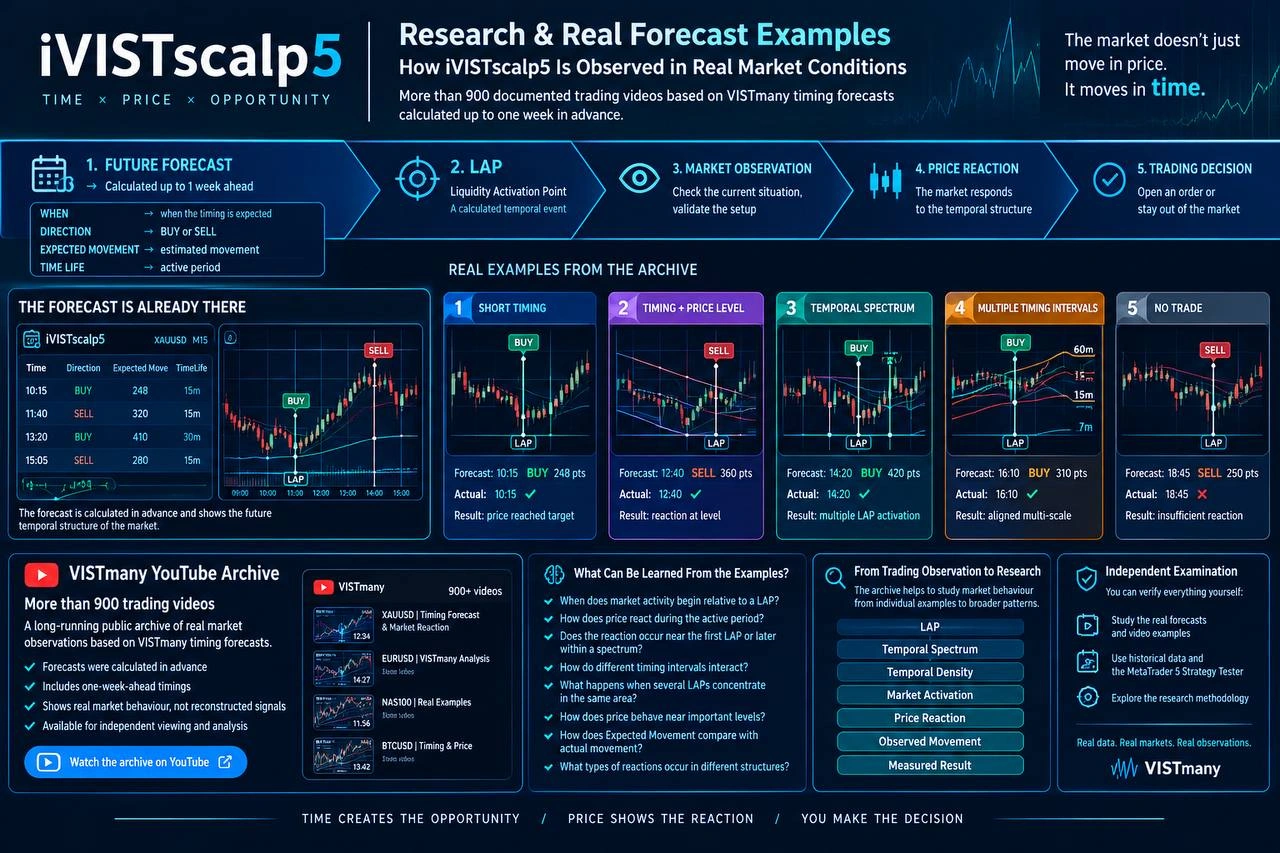
Real Forecasts, Not Retrospective Signals
An important characteristic of the VISTmany approach is the separation between the time of calculation and the subsequent market observation.
A forecasted timing is calculated before the future period being observed.
The market is then allowed to develop normally.
This makes the resulting chart or trading video a record of what happened after the forecast was already available.
The purpose is not to reconstruct a timing after seeing the price movement.
The purpose is to observe how the market behaves relative to a temporal structure that was calculated beforehand.
Real Market Examples
The following examples illustrate how a forecasted timing can be observed in practice.
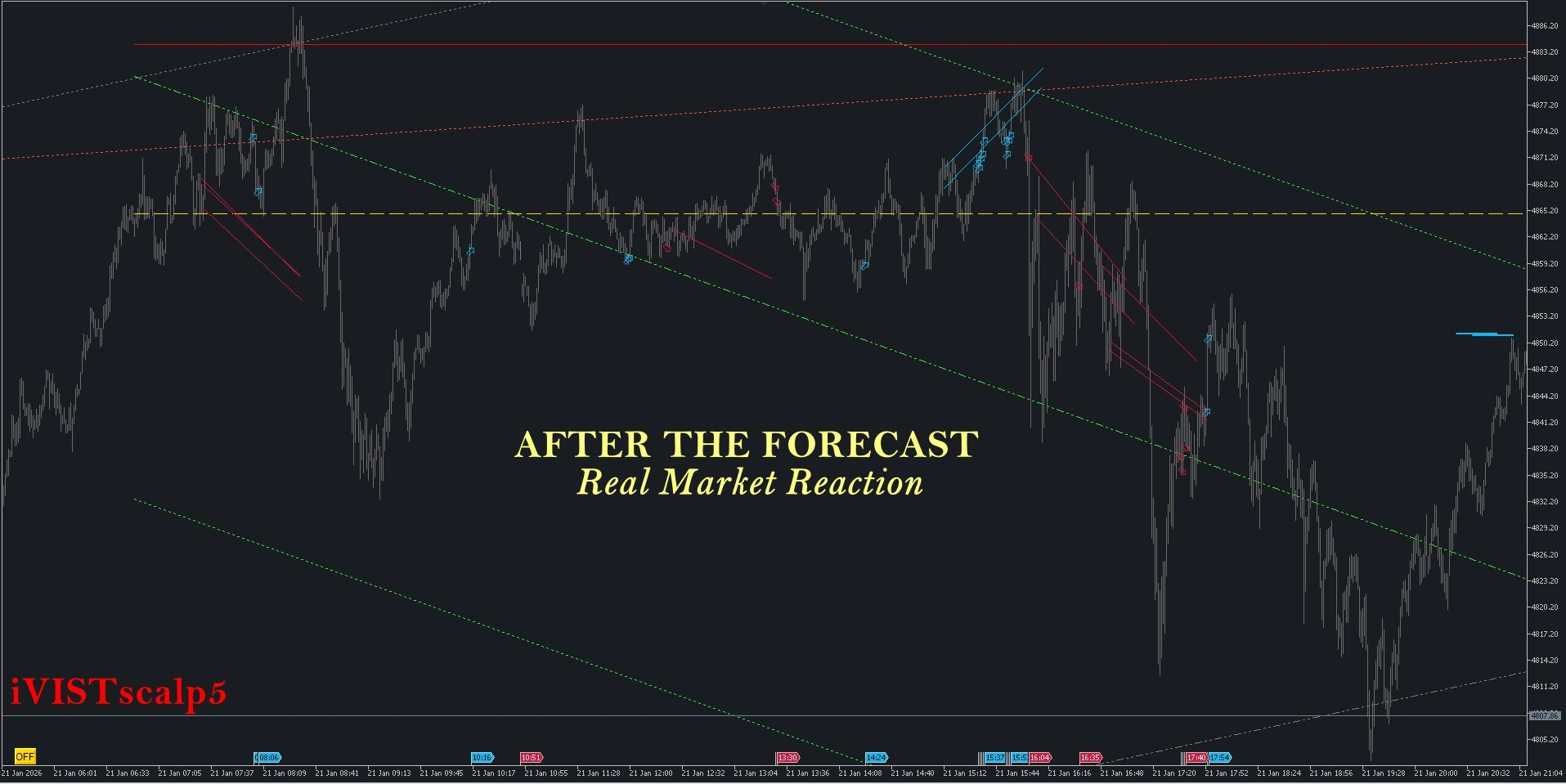
Example 1 — Future Timing and Price Reaction
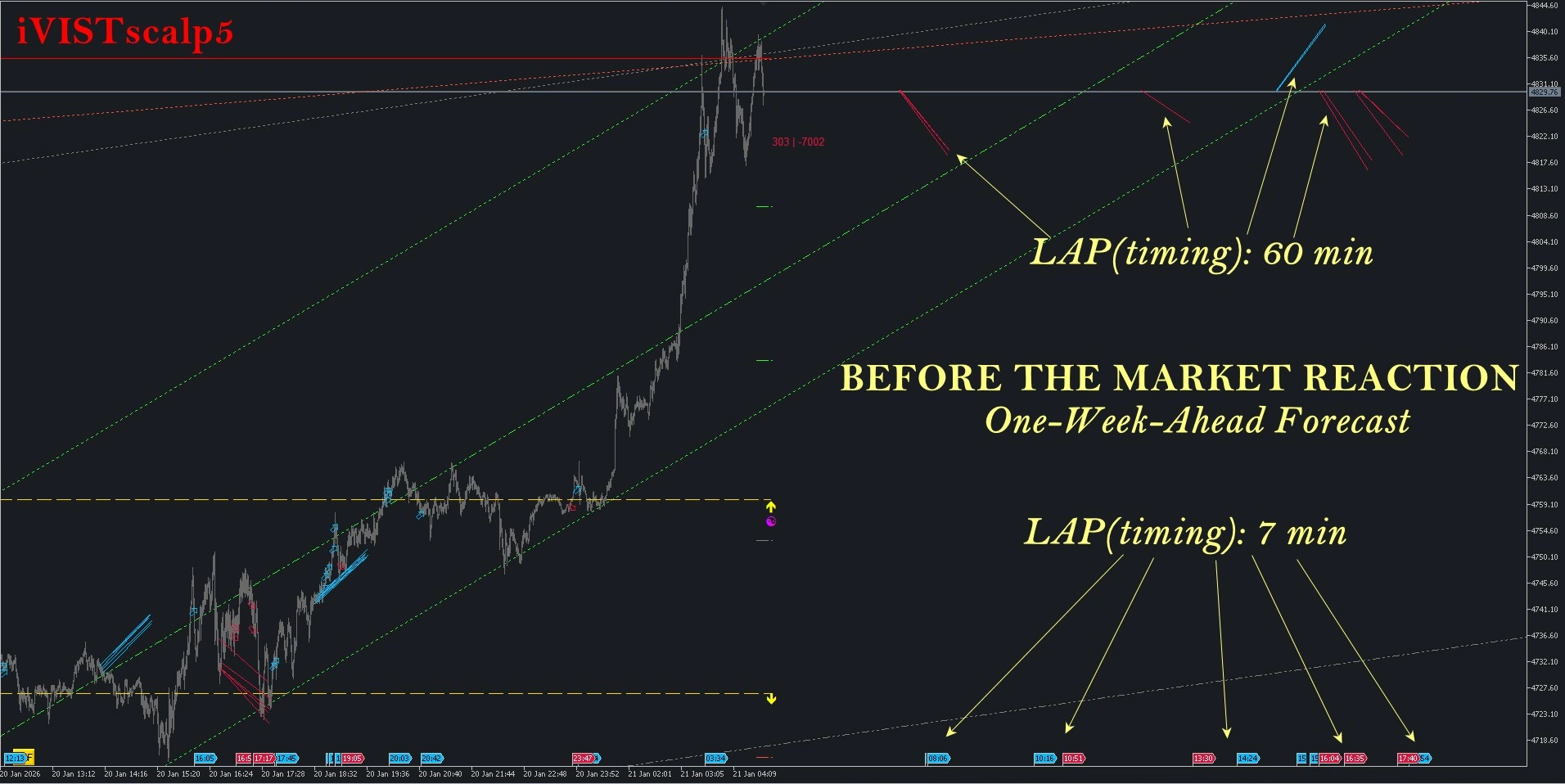
The example should show the forecast before the market reaction and then the subsequent price behaviour.
Example 2 — Timing + Price Structure
A temporal event can be studied together with the price structure displayed by iVISTscalp5.
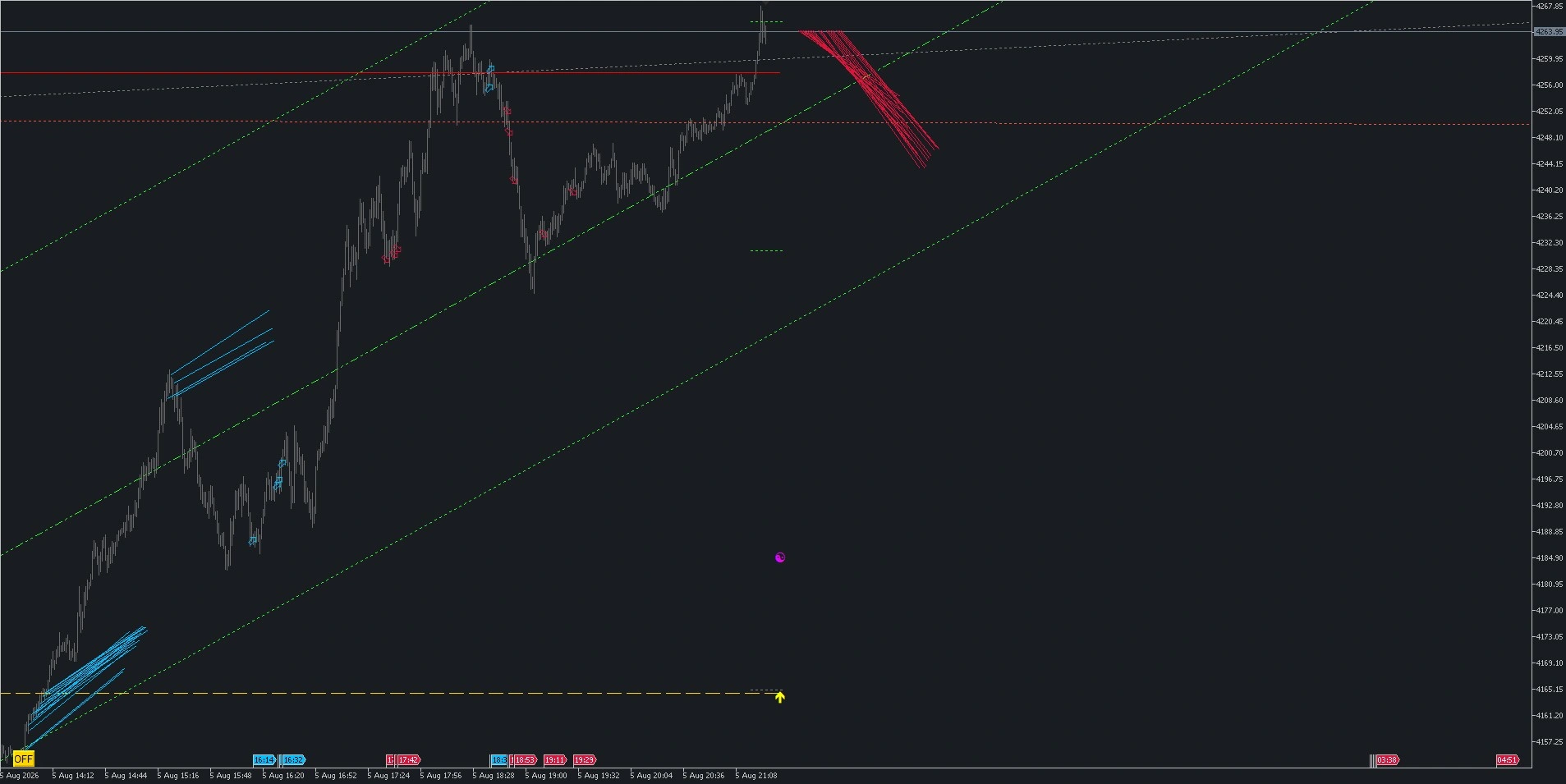
Here the timing provides the temporal context, while the price level or channel provides the price context.
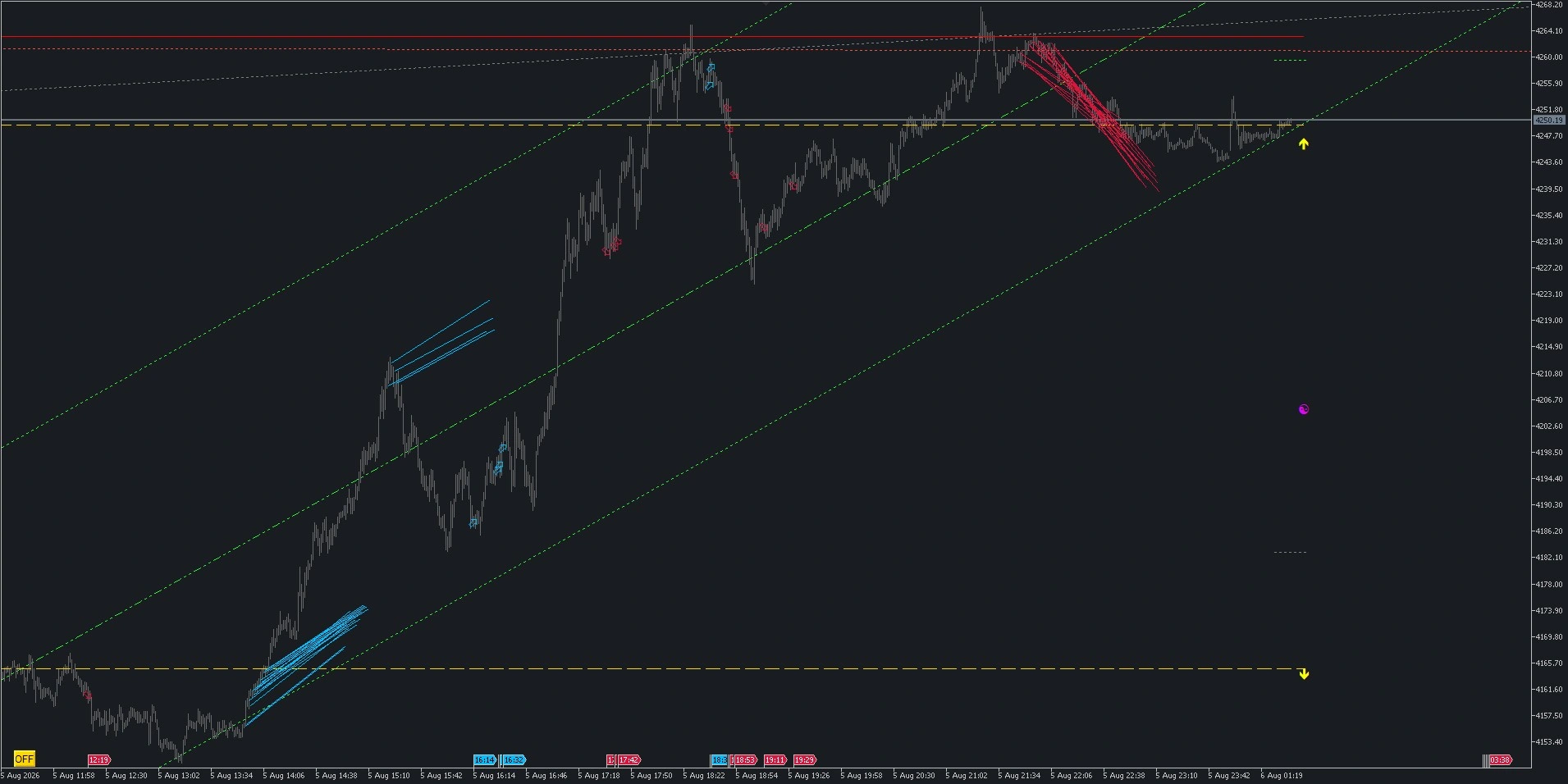
This is the practical basis of Time + Price Analysis.
Example 3 — Temporal Spectrum
Several nearby timings may form a Temporal Spectrum.
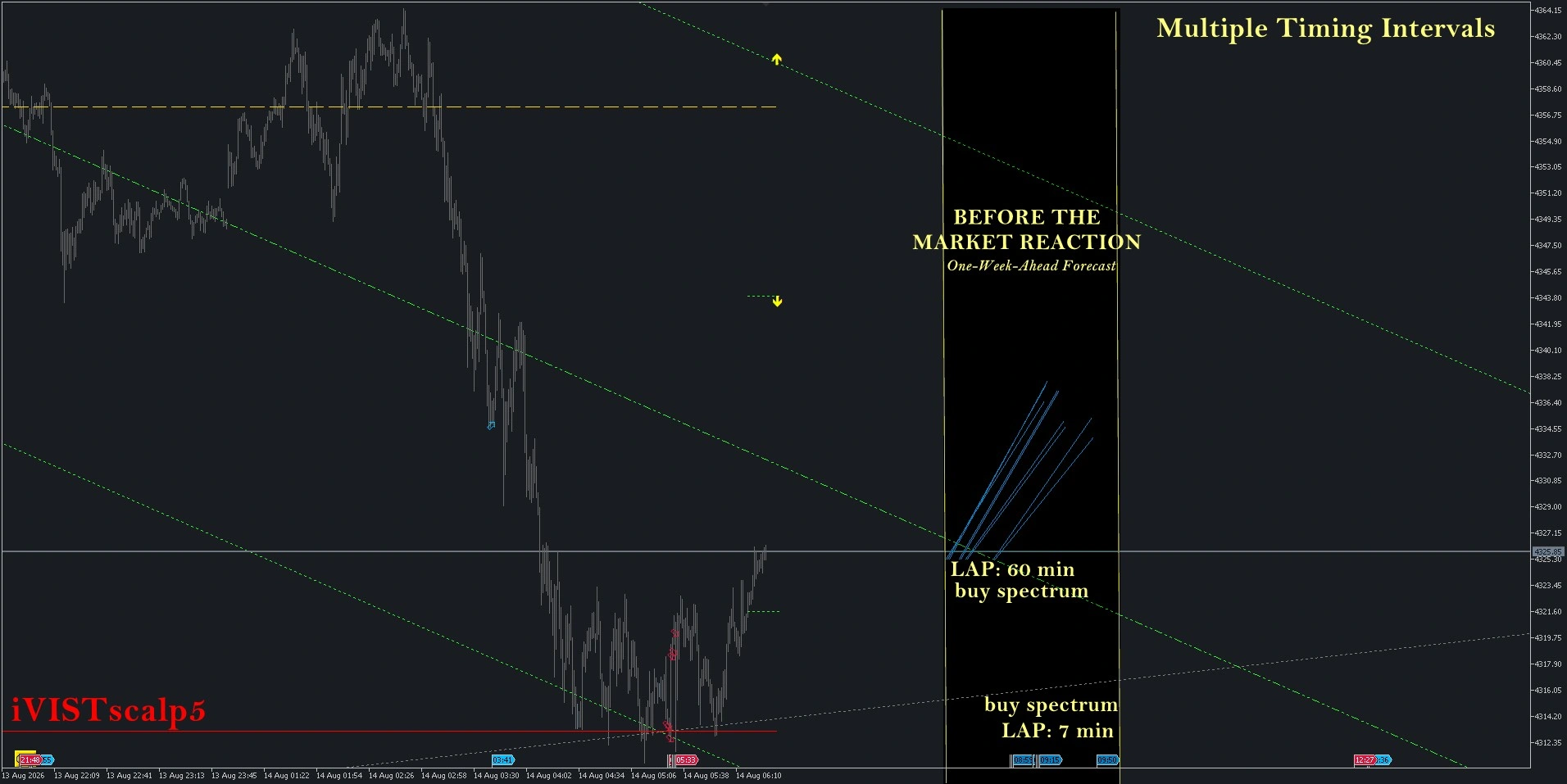
In such situations, the research question is not limited to one individual timing.
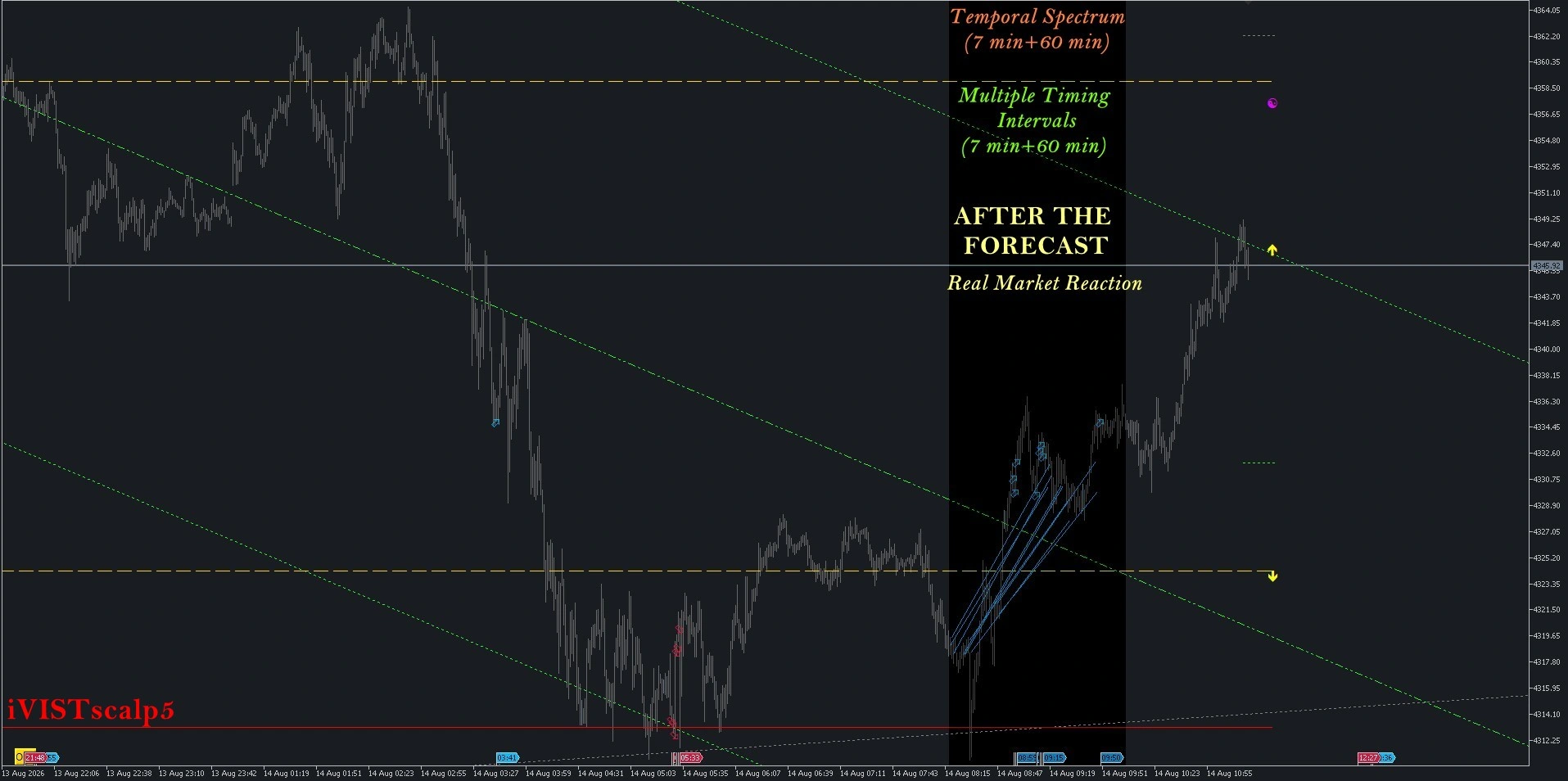
The surrounding temporal configuration can also be examined.
Example 4 — Multiple Timing Intervals
Different timing intervals can provide different temporal scales.
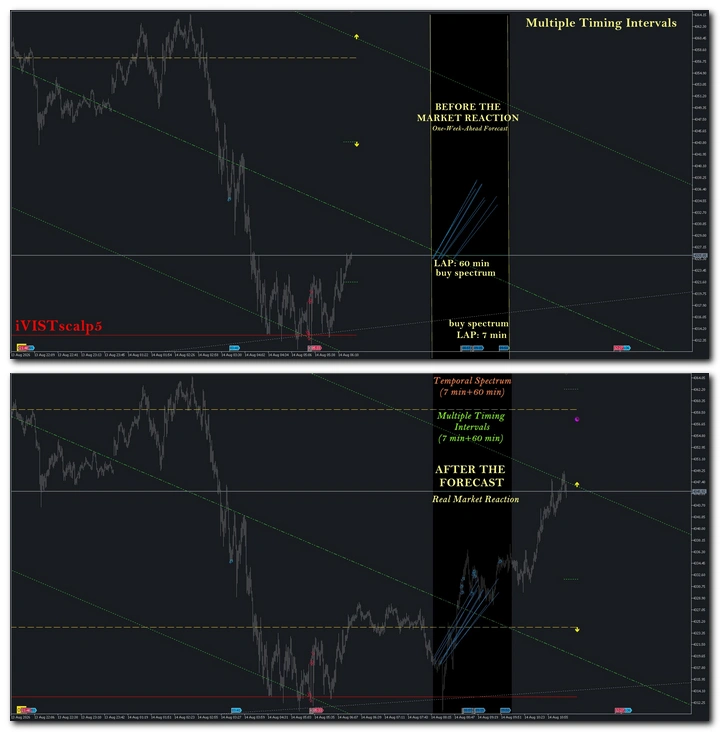
Higher timings can provide broader temporal context, while lower timings can provide greater temporal precision.
Their interaction is one of the areas studied within the VISTmany framework.
The VISTmany YouTube Archive: From Advance Forecasts to Real Market Observation
The practical history of VISTmany has been documented through a continuous connection between advance timing forecasts and subsequent real-market observations.
The process began with VISTmany timing forecasts published up to one week in advance in the project’s Telegram channels.
These forecasts were available before the corresponding future market periods occurred. The Telegram publications provide a transparent record of the forecast as it existed before the market reaction. View the Telegram forecast publication.
The next stage was the practical observation of these forecasts in the market.
Based on the forecasts published in advance, selected timing combinations were used for trading videos published on the VISTmany YouTube channel. Not every forecast was traded or recorded; the videos focused on selected combinations considered suitable for practical observation and trading.
Advance forecast → Selected timing combination → Real market observation → Trading video
In most cases, the YouTube videos also included a link to the Telegram channel where the corresponding timing forecasts had been published in advance.
This creates a direct connection between the original forecast and the subsequent market observation:
TELEGRAM
Forecast published in advance
↓
YOUTUBE
Real market observation and trading based on the forecast
↓
TELEGRAM / SOCIAL MEDIA
Video shared back with the research audience
The process was therefore not based on reconstructing a forecast after the price movement had already occurred. The forecast was published first, and the subsequent market behaviour was then observed and documented.
Over time, this process created a public archive of more than 900 trading videos based on VISTmany timing forecasts.
The value of this archive is not simply the number of videos. It is the long-term documented connection between pre-calculated future temporal forecasts and subsequent real market behaviour.
The archive provides an opportunity to examine how the VISTmany approach has been applied in real market conditions over an extended period. Open the VISTmany YouTube archive.
The forecasts and videos also became part of a broader public research trail, as video links were regularly shared through Telegram and other social-media channels.
This creates a distributed record of the development and practical use of the VISTmany methodology:
Advance Forecast → Real Market → Observation → Documentation → Public Archive
The YouTube archive is therefore not presented as a substitute for systematic statistical research. Its purpose is to preserve and demonstrate the practical history of VISTmany — how forecasts calculated in advance were subsequently observed and used in real market conditions. View a documented market observation.
What Can Be Learned From the Examples?
Individual examples are useful for understanding the practical mechanism.
A larger collection of observations makes it possible to investigate broader questions.
For example:
- When does market activity begin relative to a LAP?
- How does price react during a timing’s active period?
- Does the reaction occur near the first LAP or later within a spectrum?
- How do different timing intervals interact?
- What happens when several LAPs concentrate in the same temporal region?
- How does price behaviour change when a LAP coincides with an important price level?
- How does Expected Movement compare with the movement that actually occurs?
- What types of reactions occur around different temporal structures?
These questions move the research from individual observations toward measurable properties of market behaviour.
From Trading Observation to Market Research
A trading chart shows what happened in one particular situation.
The VISTmany research framework goes further by studying the structure behind many such observations.
The research sequence is:
LAP
↓
Temporal Spectrum
↓
Temporal Density
↓
Market Activation
↓
Price Reaction
↓
Observed Movement
↓
Measured Result
This makes iVISTscalp5 useful not only for practical market observation, but also as an instrument for studying the influence and behaviour of time in financial markets.
The Role of the Trader
The existence of a forecast does not eliminate the trader’s role.
iVISTscalp5 identifies a future temporal opportunity and provides its forecast direction and Expected Movement.
The trader then evaluates the actual market.
A notification may indicate that a forecasted timing has arrived.
The trader can check the chart from a computer or mobile device, examine the current situation and decide:
OPEN AN ORDER
or
DO NOT TRADE
This distinction is important.
The system can define when to pay attention.
The trader decides whether the current conditions justify a trade.
Why This Approach Is Practical
Continuous market monitoring can create both a significant time burden and unnecessary psychological pressure.
A week-ahead temporal forecast changes this workflow.
Instead of constantly asking:
“Where is a possible entry now?”
the trader can work with a predefined temporal framework:
“When should I pay attention to the market?”
This can make the observation process more organized and less dependent on continuous chart watching.
Push notifications further increase mobility by allowing the trader to receive information when a forecasted timing becomes relevant and then independently evaluate the market situation.
iVISTscalp5 as an Additional Analytical Dimension
iVISTscalp5 does not require the trader to abandon other forms of market analysis.
It can be used as an additional condition alongside:
- market structure;
- price action;
- volume analysis;
- volatility analysis;
- support and resistance;
- channels;
- VWAP;
- moving averages;
- or other analytical approaches.
The temporal forecast provides another question:
WHEN?
Other methods can help determine what is happening when that time arrives.
This creates a combined analytical process:
TIME → PRICE → CONTEXT → DECISION
Time as Another Plane of Market Analysis
The VISTmany approach studies the financial market from a different analytical plane.
The market is not considered only as a sequence of price changes.
It is studied through the interaction of:
TIME × PRICE
iVISTscalp5 therefore combines a forward-looking temporal layer with a price-analysis layer.
The temporal layer provides future LAPs, timing intervals, direction, Expected Movement, TimeLife and temporal structures.
The price layer provides the levels, channels and other structures required to evaluate the market reaction.
This combination makes iVISTscalp5 a complex instrument for both practical analysis and research.
Continuous Development
VISTmany is an evolving research project.
The creators of the project continuously work on improving the system, expanding its analytical capabilities and studying new properties of temporal structures.
Research is not limited to individual timings.
It increasingly examines:
- Temporal Spectra;
- Temporal Density;
- multi-scale synchronization;
- timing interactions;
- temporal energy;
- temporal gaps;
- price–time alignment;
- market activation;
- and the relationship between forecasted and observed movement.
The practical indicator and the research methodology therefore develop together.
Research & Verification
The real-market archive is one source of practical observation.
Historical testing provides another level of examination.
iVISTscalp5 can be studied using historical market data and the MetaTrader 5 Strategy Tester.
This makes it possible to move from:
VISUAL OBSERVATION
↓
SYSTEMATIC MEASUREMENT
and from individual market examples to broader empirical research.
iVISTscalp5 — Testing 7-Minute and 60-Minute LAP Timing Intervals
Watch the 7-minute and 60-minute LAP timing interval example.
The Main Principle
The purpose of iVISTscalp5 is not to tell the trader to enter the market every time a timing occurs.
Its purpose is to provide information about the future temporal structure in advance.
The practical sequence is:
ONE-WEEK-AHEAD FORECAST
↓
LAP
↓
NOTIFICATION / TIMING APPROACH
↓
MARKET OBSERVATION
↓
TIME + PRICE ANALYSIS
↓
TRADING DECISION
The trader does not have to predict everything from scratch.
The temporal framework has already been calculated.
The task is then to observe what the market does when that temporal structure becomes active.
Conclusion
The long-running VISTmany experience demonstrates a practical workflow in which future market timings are calculated in advance and subsequently observed in real market conditions.
The archive of more than 900 trading videos provides a substantial visual history of this process.
These examples are not presented as a substitute for systematic statistical research.
Their role is different: they show how the VISTmany methodology and iVISTscalp5 have been used in real market observation over time.
The broader research question is therefore not simply whether a single timing can be associated with a market movement.
It is how time, temporal structure and price interact when a calculated future temporal event becomes active.
This is the research direction of VISTmany.
Time provides the forecast structure.
Price provides the observable reaction.
The trader makes the decision.
Price Levels in iVISTscalp5
iVISTscalp5 combines its future LAP timing forecast with a structured view of price levels.
The indicator displays the main price levels and price-structure elements that help analyse where a future timing may interact with the market.
These include daily, weekly and monthly price channels, as well as additional price levels used to identify the current price structure and areas of potential interaction with future LAPs.
The combination of Time + Price provides a broader market view: LAP shows when to pay attention, while price structure helps understand where the market is positioned at that moment.
Price levels are analytical context — they do not change the calculated LAP forecast.
For definitions of core terms and practical interpretation examples, use the VISTmany Terminology page and the iVISTscalp5 FAQ. To learn how to apply timings step by step, see the VISTmany Market Timing School.
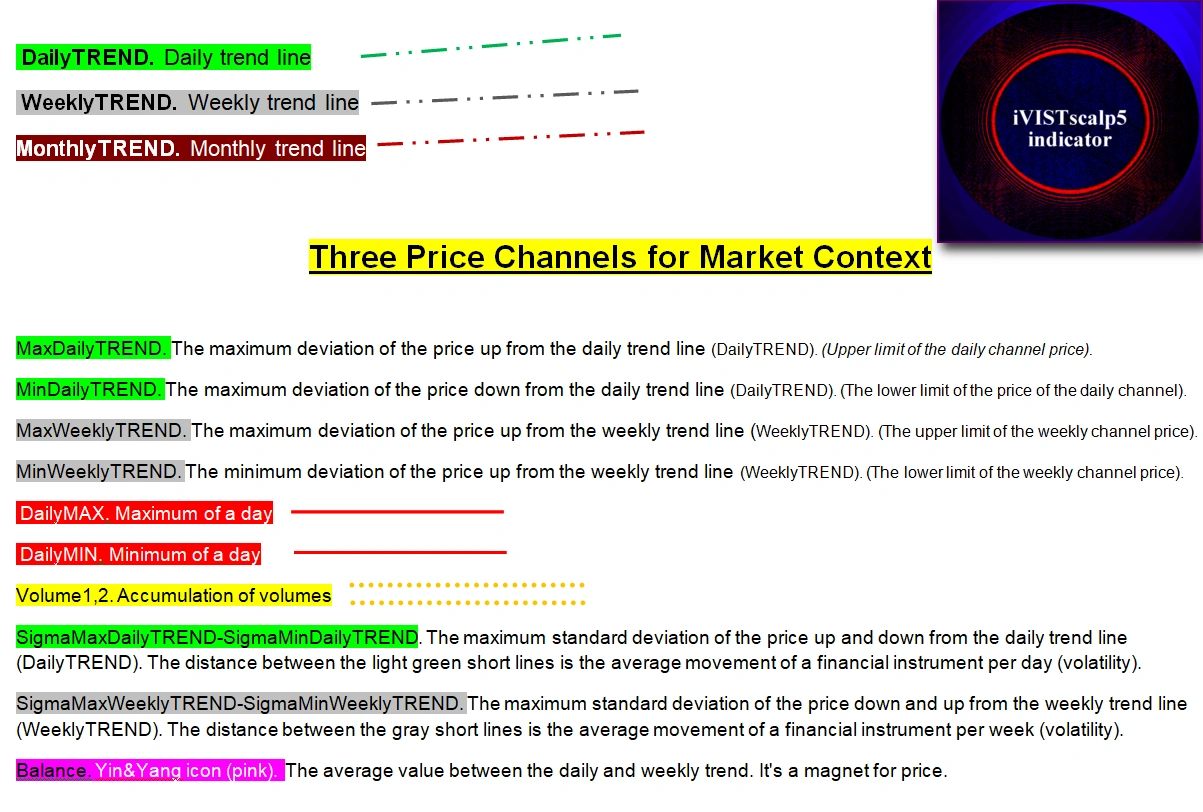
Three Price Channels for Market Context
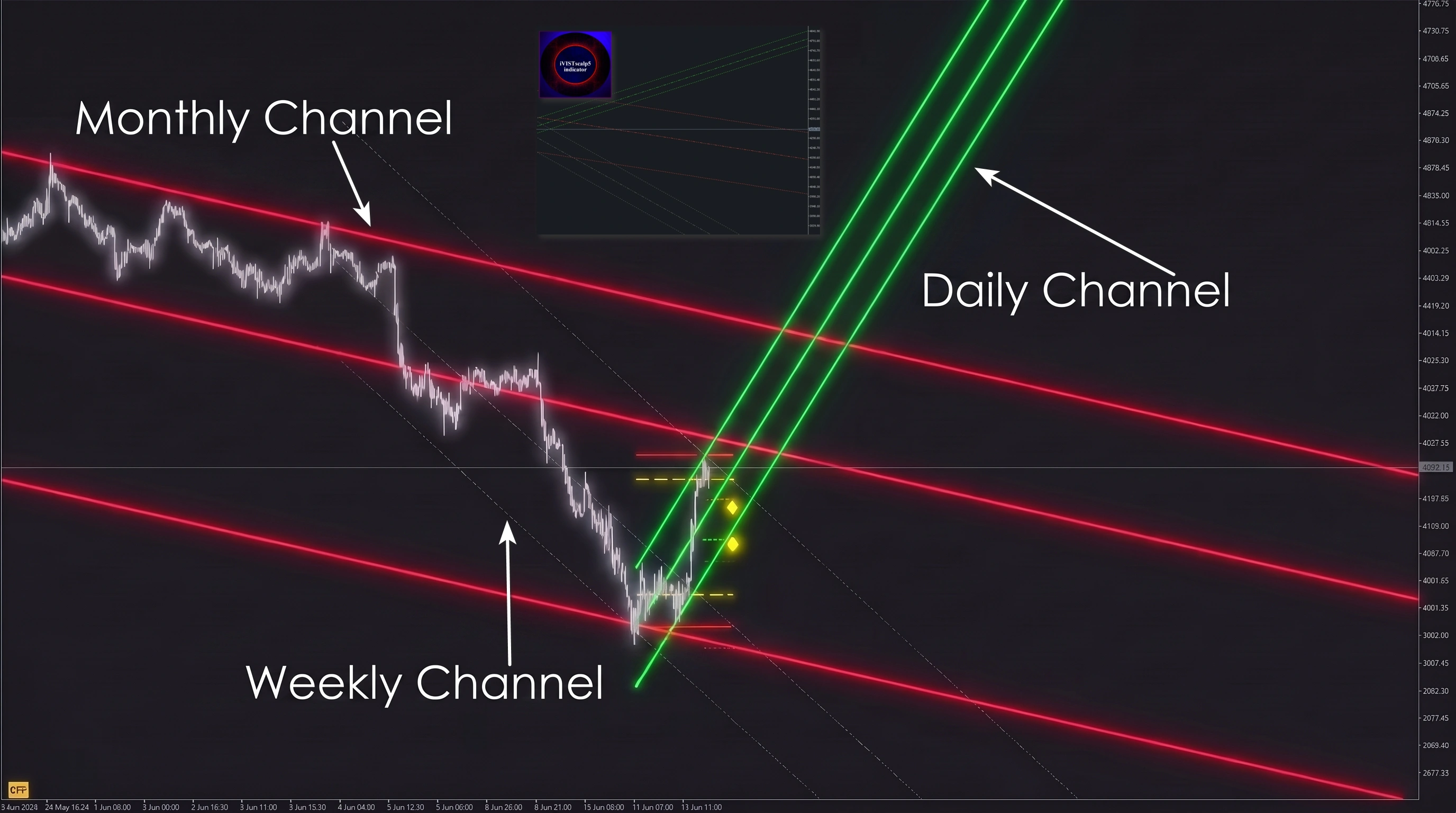
For more convenient price analysis, iVISTscalp5 provides three price channels: Daily, Weekly and Monthly.
These channels help place future LAP timings within the current price structure and provide a broader view of market behaviour across different time scales.
The price channels can be switched off completely in the indicator settings when they are not needed. This allows traders and researchers to work with the level of price context that best suits their analysis.
Time shows when to pay attention. Price provides the context.
In practical workflow, this channel view is used together with Time + Price alignment and execution guidance from the FAQ.
Sigma Levels and Weekly Trend
iVISTscalp5 includes not only timing forecasts, but also key price levels used to evaluate where price is positioned in relation to the weekly and daily structure.
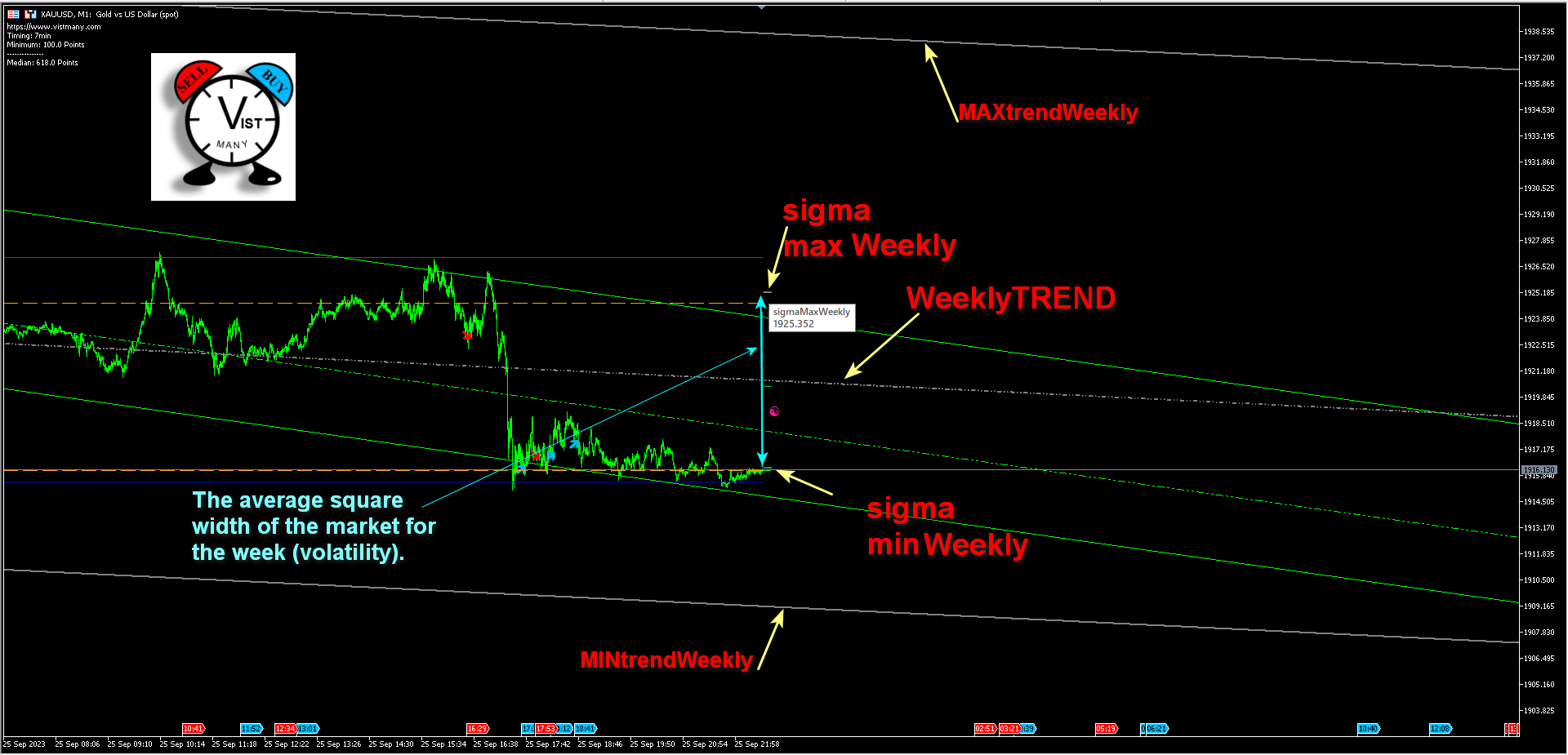
The weekly trend line (WeeklyTREND) is shown as a dashed gray line. Around this line, the indicator displays two important boundaries: SigmaMax WeeklyTREND and SigmaMin WeeklyTREND.
How Sigma Levels Are Interpreted
SigmaMax and SigmaMin represent the upper and lower standard-deviation boundaries around WeeklyTREND. In practical terms, the distance between these levels reflects the typical weekly volatility range.
When price moves beyond Sigma boundaries, market conditions may enter uncertainty zones where extremes can be updated.
How Sigma Helps in Timing-Based Trading
- If price is above SigmaMax WeeklyTREND, focus on SELL-side timing logic and avoid BUY-side setups.
- If price is below SigmaMin WeeklyTREND, focus on BUY-side timing logic and avoid SELL-side setups.
- If price is inside the Sigma range, Sigma boundaries can serve as practical reaction or take-profit reference zones.
- When a forecasted timing points into a nearby Sigma level, treat that level as a potential reaction area and adjust execution accordingly.
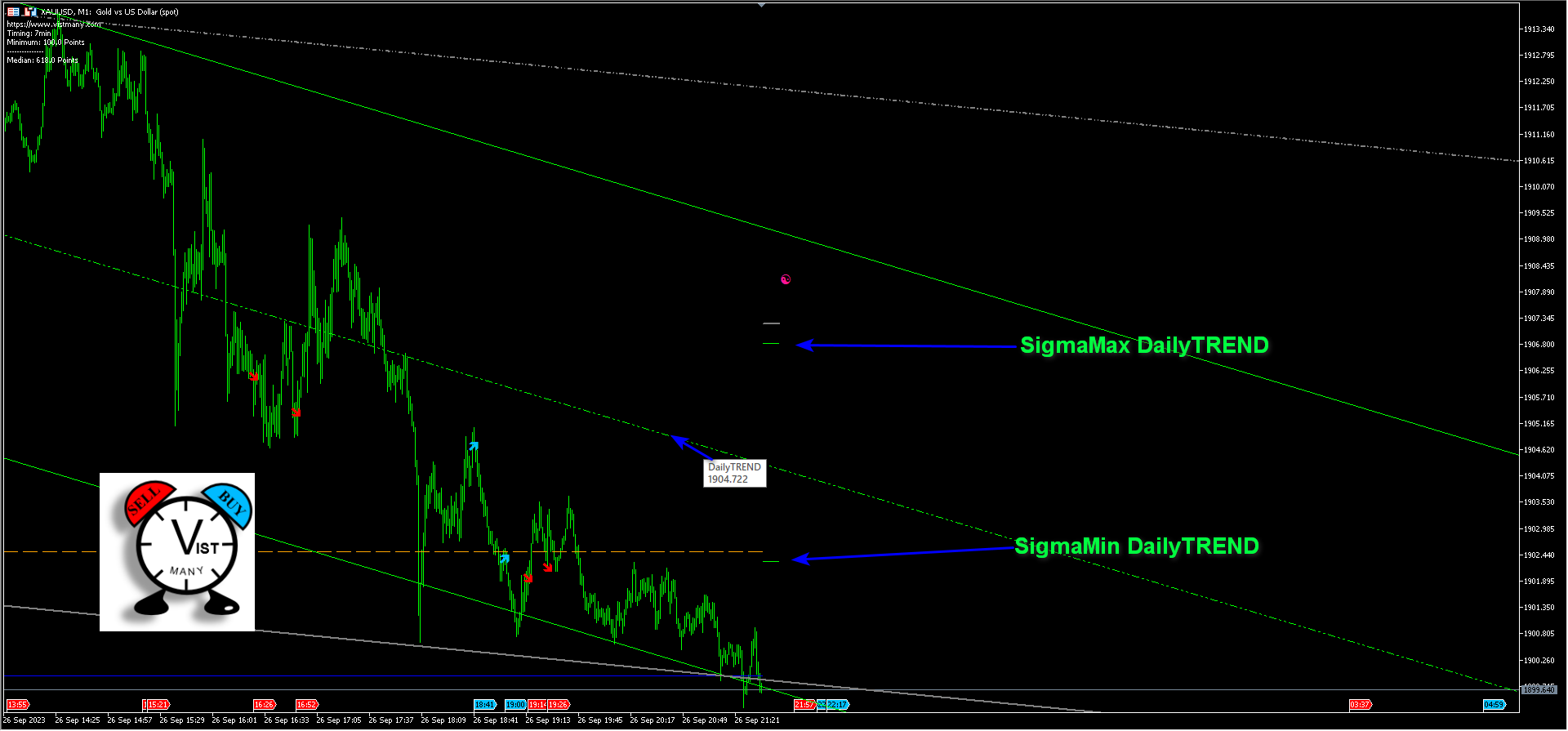
By analogy with the weekly structure, iVISTscalp5 also displays daily trend boundaries (SigmaMinDailyTREND and SigmaMax DailyTREND) to provide local price context for timing observation.
To connect Sigma observations with timing logic, compare this section with LAP, timing interval and Time + Price alignment definitions, then apply the practical checklist in the FAQ.
Temporal Spectra: How VISTmany Identifies Zones of Market Activation
Terminology: for definitions of LAP, Temporal Spectrum, Temporal Density and Temporal Space, see the VISTmany Terminology page.
Practical usage: for execution details and indicator workflow, see the iVISTscalp5 FAQ.
From Individual LAPs to Structured Timing Spectra
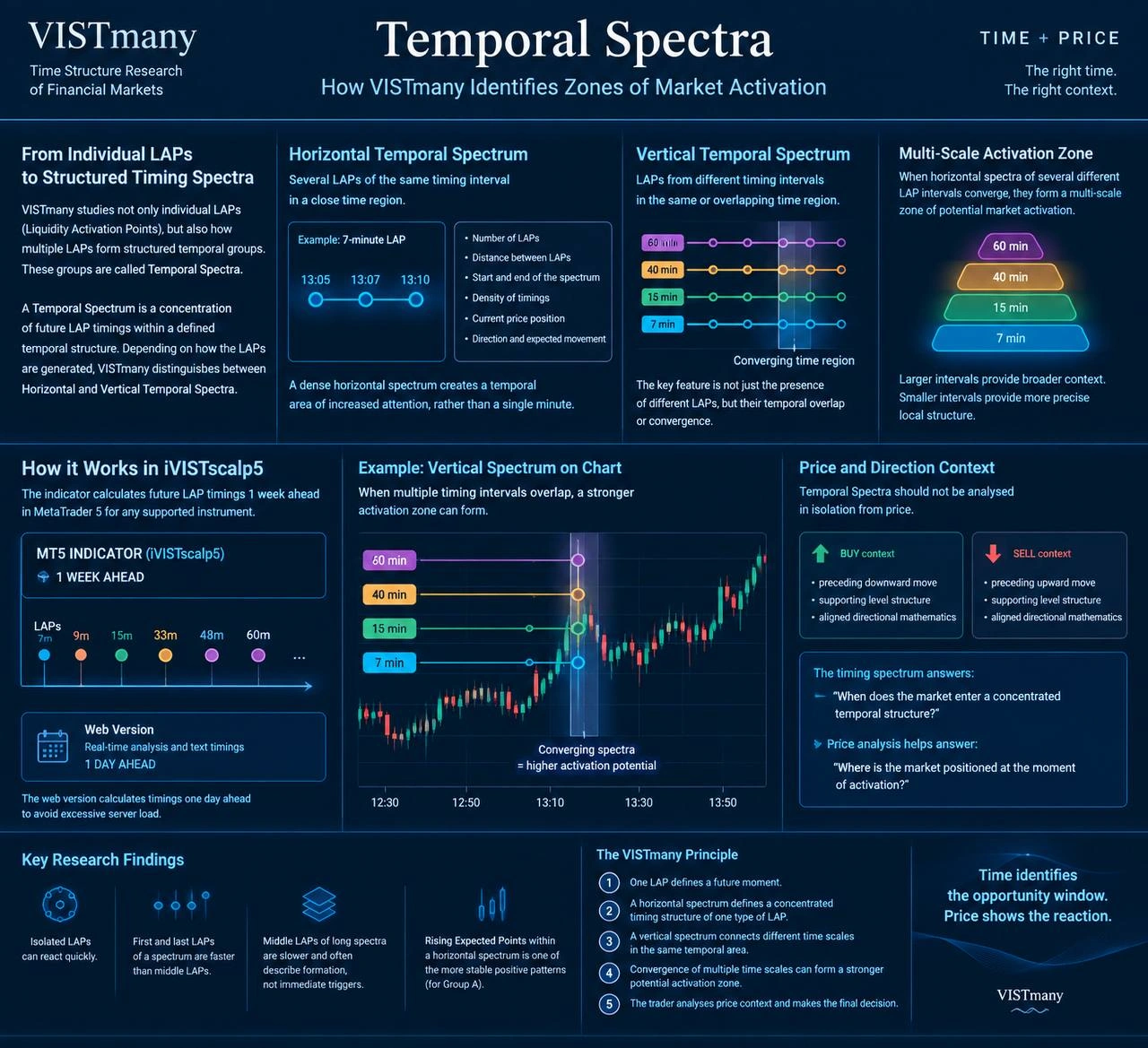
A single market timing can identify a specific future moment that deserves attention. However, VISTmany studies not only individual LAPs (Liquidity Activation Points), but also the way multiple LAPs form structured temporal groups.
These groups are called Temporal Spectra.
A Temporal Spectrum is a concentration of future LAP timings within a defined temporal structure. Depending on how the LAPs are generated, VISTmany distinguishes between Horizontal Temporal Spectra and Vertical Temporal Spectra.
This distinction is important because different types of temporal concentration can describe different stages of market activation.
Horizontal Temporal Spectrum
A Horizontal Temporal Spectrum consists of several LAPs generated by the same timing interval and concentrated within a relatively close time region.
For example, consider a 7-minute LAP interval:
13:05 → 13:07 → 13:10
These are LAP timings generated within the same timing structure.
Instead of treating them as three completely independent timings, the group can be analysed as a 7-minute Horizontal Temporal Spectrum.
The important information is not only the existence of each individual LAP, but also:
- the number of LAPs in the spectrum;
- the distance between neighbouring LAPs;
- the beginning and end of the spectrum;
- the density of LAPs;
- the position of the current market relative to the spectrum;
- the direction associated with the LAPs;
- the expected movement associated with the timings.
A dense Horizontal Spectrum can therefore define a temporal area of increased attention, rather than a single exact minute.
Vertical Temporal Spectrum
A Vertical Temporal Spectrum is formed when LAPs from different timing intervals occupy the same or strongly overlapping temporal region.
For example, a market may simultaneously contain:
- LAP 60 minutes;
- LAP 40 minutes;
- LAP 15 minutes;
- LAP 7 minutes.
If the horizontal spectra generated by these different timing intervals converge in the same temporal region, the structures form a Vertical Temporal Spectrum.
The key feature is therefore not simply that several different LAP intervals exist.
It is that their temporal structures overlap or converge around the same future period.
This creates a multi-scale temporal concentration.
Multi-Scale Activation Zones
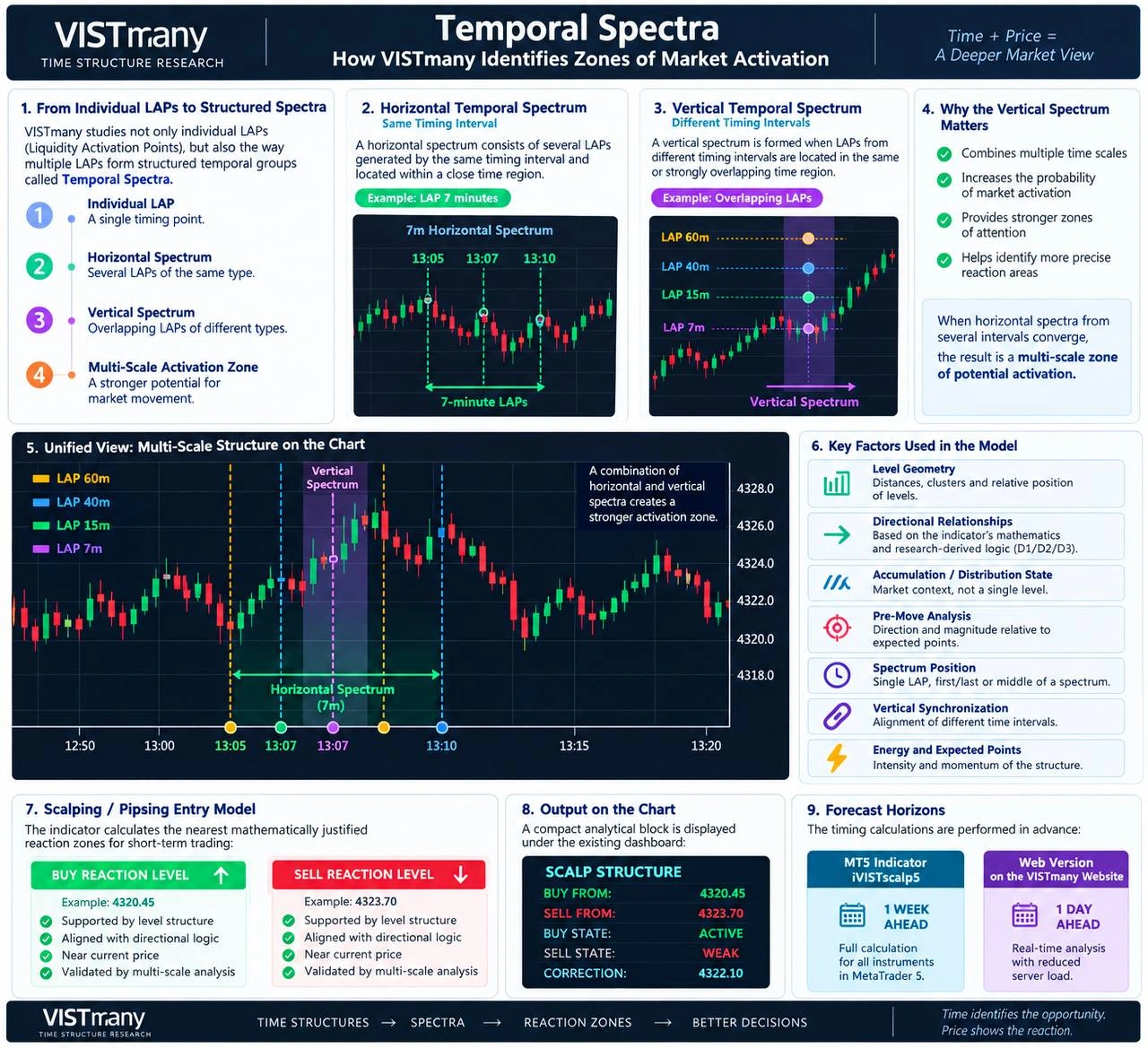
When Horizontal Spectra from several different LAP intervals converge in the same temporal region, the result can be viewed as a multi-scale zone of potential market activation.
For example:
60-minute spectrum
↓
40-minute spectrum
↓
15-minute spectrum
↓
7-minute spectrum
When these structures concentrate around the same future time region, the market is being observed simultaneously through several temporal scales.
The larger intervals provide broader temporal context.
The smaller intervals provide increasingly precise local structure.
This is one of the important ideas behind the VISTmany concept of Temporal Space: future market activity can be studied as a structured temporal environment rather than as a sequence of isolated signals.
Why the Vertical Spectrum Matters
A single 7-minute LAP may represent a local timing event.
A group of 7-minute LAPs may form a Horizontal Spectrum.
But when that spectrum is supported by overlapping structures from 15-, 40-, and 60-minute LAPs, the same temporal region contains information from several scales simultaneously.
Such a configuration can represent a strong potential activation zone.
It does not mean that price must move in a particular direction or that every LAP should be traded.
Instead, it identifies a future temporal region where the concentration of independently calculated timing structures deserves increased attention.
The direction, expected movement and price context must still be analysed.
Timing Direction and Price Context
Temporal Spectra should not be interpreted independently of price.
For example, a BUY-oriented spectrum should be studied together with the preceding price movement and current price structure.
Likewise, a SELL-oriented spectrum should be considered in relation to the preceding upward movement and the surrounding price structure.
The temporal spectrum answers primarily:
When is the market entering a concentrated timing structure?
Price analysis helps answer:
Where is the market positioned when that temporal structure becomes active?
This is the basis of the VISTmany Time + Price approach.
One-Week-Ahead LAP Forecast in iVISTscalp5
A fundamental feature of the VISTmany methodology is that iVISTscalp5 calculates LAP timing forecasts one full week ahead in MetaTrader 5.
For any supported financial instrument, the MT5 indicator calculates future timing structures for the coming week.
This means that Horizontal and Vertical Temporal Spectra can be studied before the corresponding market period occurs.
The forecast provides a forward-looking temporal map containing future LAPs, their timing intervals, direction and expected movement.
This is different from identifying a timing only after the corresponding price movement has already occurred.
Web Version of iVISTscalp5
The official VISTmany website also provides a web version of iVISTscalp5 for real-time timing analysis.
To avoid excessive server load, the web version calculates and displays timing forecasts one day ahead, rather than performing the full one-week-ahead MT5 calculation.
Therefore the two formats have different calculation horizons:
iVISTscalp5 in MT5:
1 week ahead
iVISTscalp5 web version:
1 day ahead
The underlying VISTmany concept remains the same: future LAP timings are calculated first, and subsequent market behaviour can then be observed in relation to those calculated temporal structures. For practical interpretation rules, cross-check with the FAQ.
Temporal Spectra as Research Objects
Temporal Spectra allow VISTmany to move beyond the analysis of individual timings.
The research question becomes:
What happens when several future temporal structures begin to concentrate in the same region of time?
This makes it possible to study:
- temporal density;
- multi-scale synchronization;
- Horizontal Spectra;
- Vertical Spectra;
- activation zones;
- direction alignment;
- expected movement;
- price reaction;
- temporal expansion and decay.
A Temporal Spectrum is therefore not simply a collection of signals.
It is a structured configuration of future temporal coordinates.
The VISTmany Principle
The central idea can be expressed simply:
One LAP identifies a future moment.
A Horizontal Spectrum identifies a concentrated timing structure.
A Vertical Spectrum connects different timing scales in the same temporal region.
A multi-scale convergence can define a stronger potential market activation zone.
And throughout the process, the trader remains responsible for interpreting price context and making the final decision.
Time identifies the opportunity window. Price shows the reaction.
Two-way navigation: use the Terminology definition of Temporal Spectrum for conceptual precision, and return to this section to see the same concept applied in practical market context. For execution questions, continue in the iVISTscalp5 FAQ.
Timings is an innovative scalping system. From idea to implementation. Basic concepts of time levels (timings).