The Temporal Coordinate System: Establishing Time as an Independent Dimension of Financial Markets
Introduction
Since the earliest financial models, charts have represented markets using two variables:
Price
Time
However, these variables have never possessed equal analytical status. Price has always been considered the observable phenomenon. Time has merely been treated as the horizontal axis upon which price is plotted. This asymmetry has fundamentally limited financial analysis. The VISTmany methodology proposes reversing this perspective. Instead of asking:
“How does price evolve over time?”
it asks:
“What structures exist inside Time independently of price?”
Time as an Independent Coordinate
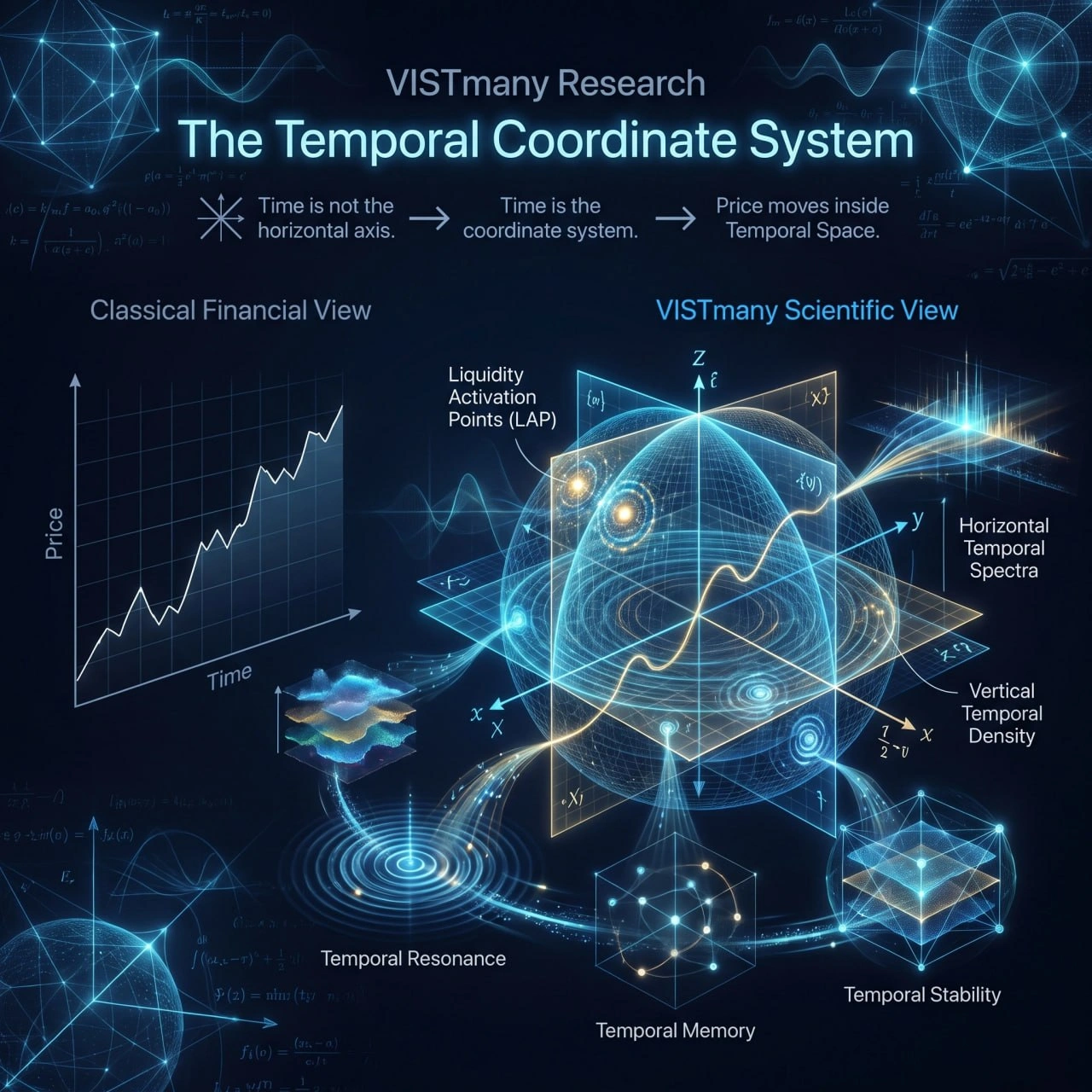
In physics, coordinate systems describe independent dimensions. Space is not created by objects. Objects move inside space. Similarly, VISTmany proposes that financial prices do not create Temporal Space. Instead, prices evolve inside an already existing temporal coordinate system. This distinction is fundamental. Time ceases to be a passive measurement. It becomes an active coordinate capable of organizing market behavior.
The Temporal Coordinate System
The proposed Temporal Coordinate System consists of multiple interconnected temporal structures:
- Liquidity Activation Points (LAP),
- Horizontal Temporal Spectra,
- Vertical Temporal Density,
- Multi-Spectral Synchronization,
- Temporal Memory,
- Temporal Stability,
- Temporal Resonance.
Independence from Price
One of the strongest empirical observations supporting the Temporal Coordinate System is the persistence of LAP structures across changing price environments. The same temporal structures continue to appear despite:
- changing volatility;
- changing trends;
- changing market participants;
- different financial instruments.
Scientific Implications
If Time represents an independent analytical dimension, then financial markets require a fundamentally different mathematical description. Instead of modeling only stochastic price evolution, future quantitative finance may incorporate temporal coordinate fields capable of describing liquidity activation before observable price movement occurs. This perspective aligns naturally with complex systems theory, dynamic field modeling, and multidimensional market analysis.
Conclusion
The Temporal Coordinate System extends the theoretical foundation of VISTmany by establishing Time as an independent analytical dimension rather than a passive measurement axis. This concept provides the framework within which Liquidity Activation Points, Temporal Spectra, Temporal Density, and Temporal Resonance become interconnected components of one coherent scientific model. The recognition of Time as an independent coordinate may represent one of the next major paradigm shifts in quantitative financial research.
For the formal definitions of these concepts, see the VISTmany Terminology page, especially Temporal Space, Temporal Spectrum, and Temporal Density.